

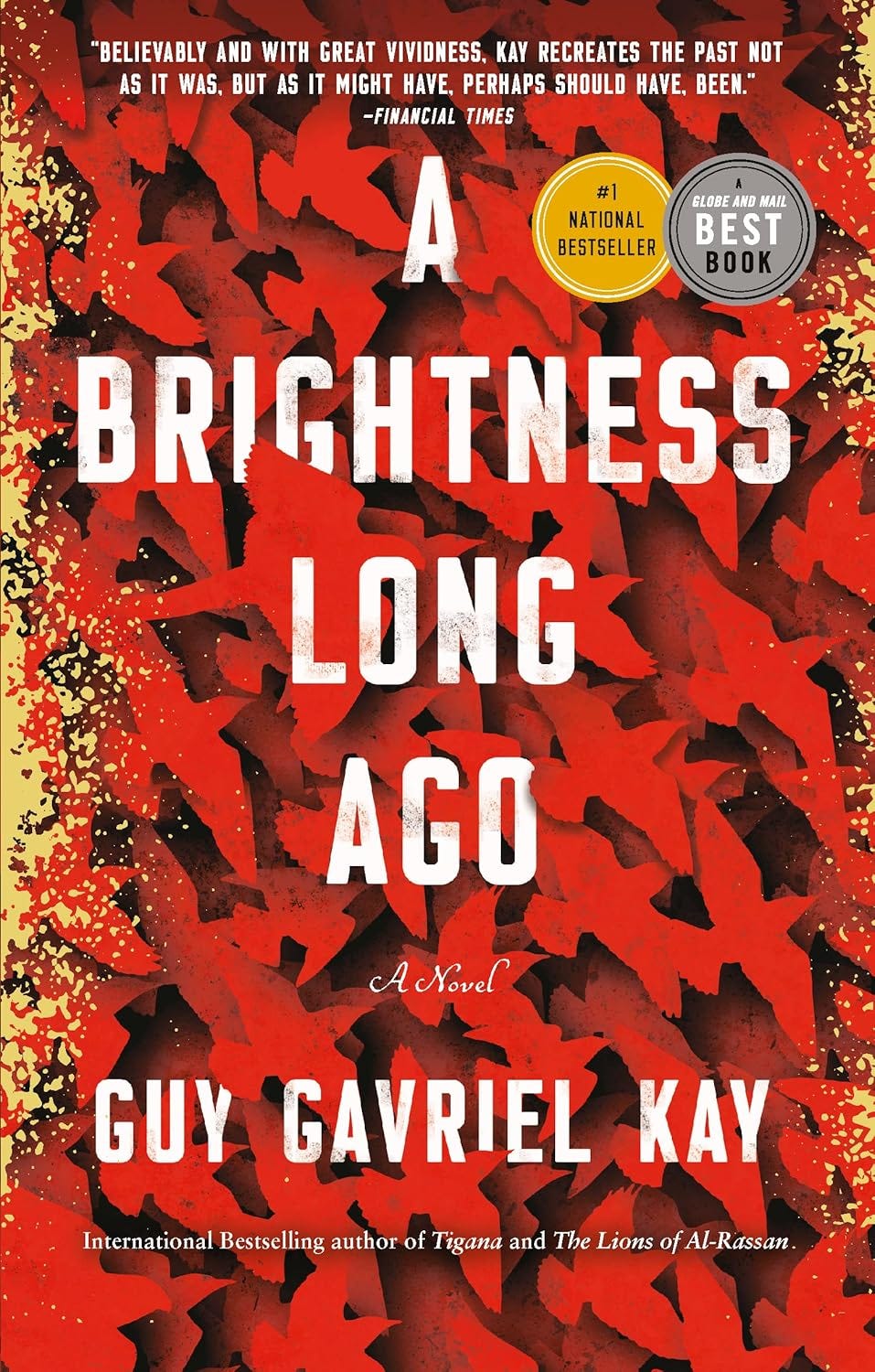
A Brightness Long Ago
Guy Gavriel Kay
A quarter turn from Renaissance Italy
In reviewing Guy Gavriel Kay‘s novel The Last Light of the Sun I noted
Most of GGK‘s novels have an element of fantasy. In some of them it is small -- that is, there is magic, but it is peripheral to the story. You could delete all the magic from the story, make a few small additional changes, and events would proceed in much the same way.
A Brightness Long Ago is one of those.
Brightness is one of GGK‘s Quarter Turn Towards Fantasy historical novels, in which the characters, places, and locations resemble identifiable real-world ones. (Often, but not always, these are explicitly named by GGK in the acknowledgements.) This one in particular is set entirely in GGK‘s Batiara, which is his quarter-fantasy version of Italy. It is a distant sequel to his Sarantine Mosaic duology. About a thousand years have passed since the events of those books.
That places us in Renaissance Italy. At this time (both in Italy and Batiara) Italy was not what we would now recognize as a nation. Rather, it was a collection of feuding, warring, and intriguing city states. In this world Seressa (quarter-turn Venice) was a navel power on the world stage. Firenta (Florence) is becoming a banking power and Macera (Milan) is a European power. Rhodias (Rome), once the center of a religious empire, is no longer quite that. The Eastern capital of the Empire, Sarantium (Constantinople) has largely supplanted it.
A minor character, the artist Matteo Mercati, is clearly based on Michelangelo (1475 – 1564), and the city of Sarantium falls to the Asharites (Moslems) during the course of the novel. The fall of Constantinople occurred in 1453. Armies in the novel reduce city walls with field cannon that fire stone balls. Facts like these are among those that place us in Renaissance Italy. Mathematicians will have noted already that Constantinople did not fall during Michelangelo’s lifetime. GGK is blurring the lines a bit.
The story is told in the first-person by Guidanio (Danio) Cerra, the son of a Seressan tailor. It is written as the recollections of a middle-aged Danio. Thus we know from the start that Danio will survive the events of the novel. Other characters get no plot armor. There are several deaths of major characters. Danio is not a scrupulous first-person narrator -- he often tells us of things he could not really have known, such as the thoughts of a person shortly before their death. I think we are meant to understand the story as coming partly from Danio’s imagination, but with no great leaps. These are people Danio knew, and events he knew about, perhaps at second-hand.
It’s an exciting story, very well told. Danio is a sympathetic and intelligent narrator. Characteristically, GGK does not tell a one-dimensional story of hard men whacking each other with sticks. There are women and scholars and artists and intellectuals, as important in their ways to the currents of history as the soldiers. I will continue with the Sarantine Universe novels.