

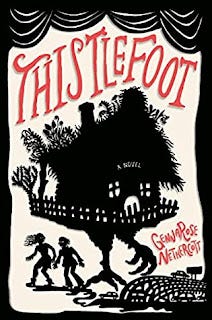
Thistlefoot
GennaRose Nethercott
Baba Yaga comes to the USA
This was so good.
My first impression of Thistlefoot was the cover art, which shows a cottage walking on chicken feet. I instantly recognized it as the home of Baba Yaga, one of the central figures of Russian folklore. Baba Yaga is a witch or a goddess or a trickster. She flies around in a mortar. (I admit, I have difficulty picturing that.) She is an ugly old hag but can also appear as a beautiful young woman. (Hey! Don't blame me! I'm not the one who made this stuff up.) She is always scary, but seldom clearly good or evil. She is often the form in which justice shows up in her stories.
Don't worry! You don't need to know about Baba Yaga before reading Thistlefoot. GennaRose Nethercott recounts several stories of Baba Yaga in the book. These are not exactly the traditional Baba Yaga stories -- they are Nethercott's own versions. She is entirely open and unapologetic about inventing new folklore -- as she writes at the end of Thistlefoot's final chapter,
If a story does its job, it doesn’t ever end. Not really. But it can change. This is the nature of folktales. They shift to fit each teller. Take whatever form suits the bearer best.
Case in point: while Baba Yaga is, I believe, a pan-Russian folkloric figure, the Baba Yaga of Thistlefoot is unambiguously Jewish.
That was my first impression of Thistlefoot -- even before I began to read, I knew it would be a Baba Yaga story. Second, when I began to read, I was immediately delighted by Nethercott's prose style. While I am not usually one to consciously note a writer's style (although of course it affects my experience, as it does every reader's), the life and vividness of Nethercott's style grabbed my attention. In her Acknowledgements Nethercott thanks
Ray Bradbury and Angela Carter: the devils on my shoulders pushing my prose to be as candy-coated and purple as I damn well please.
Nethercott's prose isn't really candy-coated and purple. Also, she doesn't remind me of Bradbury. When I read Bradbury, I notice his style, too -- it is the style of a man shrieking "I am an Artist with a capital A! Notice me!" Nethercott's writing isn't like that. It's not oriented towards her, the author, but towards me, the reader. In fact, Nethercott reminds me of Alexandre Dumas père whose writing (especially in the original French) is similarly vivid.
The two main protagonists are a young American brother and sister. The brother, Isaac Yaga, is a sketchy vagrant who subsists by petty crime. His sister, Bellatine, is a woodworker, a steady, reliable person. They grew up as puppeteers, but left their mother's home. The story begins when Bellatine and Isaac receive letters telling them to come to New York to receive a shipment from Russia -- a mysterious something that once ostensibly belonged to their great-great-grandmother. The shipment, which arrives in a huge container, turns out to be a house on chicken legs. The house responds to directions in Yiddish. Isaac convinces Bellatine to take Thistlefoot (as the house is called) on tour to present their family puppet show. It transpires that they are pursued by a malevolent entity called the Longshadow Man.
And that's where, to avoid spoilers, I will have to leave off. (By the way, what I have recounted so far is in the publisher's blurb -- therefore I do not count it as spoiling. And it really does not. You do not, based on what I've told so far, know where the story is going.)
Now, I want to add a warning. I imagined when I started Thistlefoot, that it would be a typically light-hearted fantasy. It is not. It has its gentle and funny moments. But the base story is rooted in the history of Russian Jews, which was often brutal and harsh. Nethercott tells us, in so many words, that she writes to preserve the memory of those events. Be prepared.