

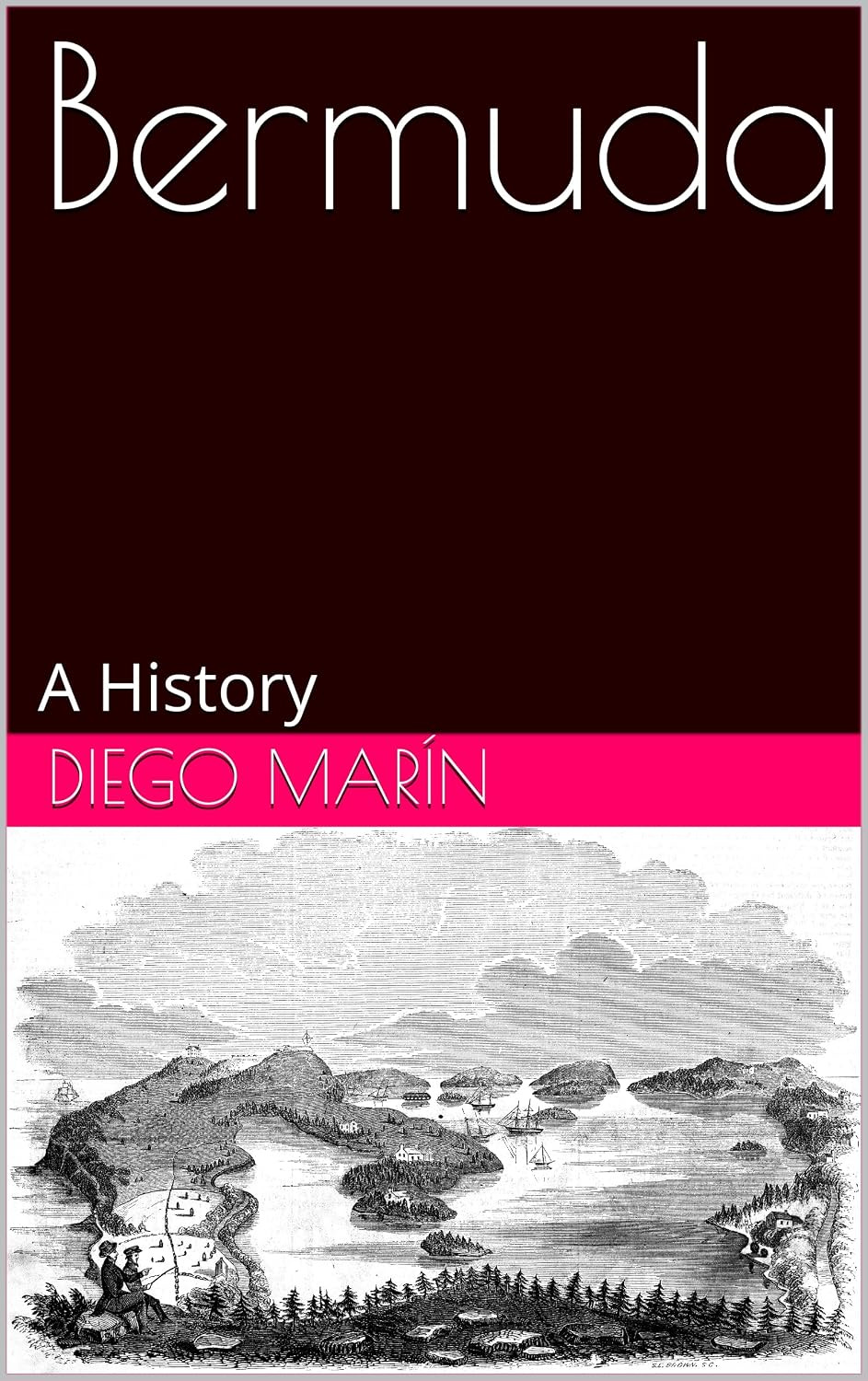
Bermuda: A History
Diego Marín
Betwixt and between
I am writing a story set in Bermuda. What I knew about Bermuda before reading this history was very little1. I knew it was an isolated island in the middle of the North Atlantic Ocean between North America and Europe, but much closer to America. It is far enough south to have a tropical climate, but well north of the Bahamas and other famous Caribbean destinations. It is majority black. This was, as far as it went, mostly right. The one correction necessary is that Bermuda is not a single island, but an archipelago of almost 200 chunks of rock that stick out about the water. (As a practical matter, the main islands are now all joined by bridges and causeways, so from the twentieth century on one doesn't go far wrong by thinking of it as a single very crinkly island.)
I knew and know very little about Diego Marín. There is no "About the Author" page. I surmise that he is an elderly man who has lived in Bermuda most of his life, educated, quite possibly a lawyer or in some law-adjacent profession, intimately familiar with Bermuda and its history, fond of Bermuda and an engaging writer.
For most of its history, Bermuda has been a British territory. This started when an expedition intended to save the failing colony at Jamestown, Virginia, shipwrecked on Bermuda on its way. And for most of its history it has struggled to play off its powerful nearest neighbor, the USA, against its British identity. There's a wonderful story about this from the beginning of the American Revolution (thus, before the USA existed as such).
In 1775 the Continental Congress passed a law forbidding all trade with England or any of its colonies. This would have been devastating to Bermudian traders. A delegation of them sailed to Philadelphia to make a deal. They asked to be exempted from the embargo. The deal was that Bermuda could be exempted, if they would supply American revolutionaries with gunpowder, which the Americans were very short of. The Bermudian traders sailed back to Bermuda, snuck into the building in which powder for the British army and navy was stored, and took every bit of it. They loaded it into two American vessels anchored in a secluded bay. Thus, at the beginning of the Revolutionary War, bullets fired at English soldiers by Washington's armies were impelled by English gunpowder stolen from Bermuda.
When America (now actually the USA) and England went to war once again in 1812, Bermudian privateers made good money by capturing American merchant vessels. This is one of those cases where the scandal is not that what anyone was doing was illegal, but that what they was doing was completely legal. In time of war a nation can give sailors legal permission to commit acts that, under any other circumstances, we would call piracy. Some decades later during the American Civil War the Union blockaded the South. Bermudian sailors made good money as blockade runners—they brought goods past Union blockaders to the Confederacy. When in the early 20th century the USA made it illegal to buy or sell liquor, Bermuda was there once again to smuggle rum.
Of course, Bermuda had its own internal turmoils. In 1834 slavery was abolished throughout the British Empire, including Bermuda. As has happened in so many places the slaves were nominally freed, but kept underfoot economically and socially. That fight continues still.
Bermuda is now a wealthy place. It's small—the population is around 65,000, about that of a small city. Its GDP is $9.2B for a per capita GDP of $143,878. Its main industry, aside from tourism, is reinsurance. It is a tax haven. Insurance companies head-quartered in Bermuda pay little to no tax. Marin points out with some indignation that Bermuda's reputation as a nest of money-laundering is totally unfair -- its lawmakers have worked hard to make Bermuda a model of financial transparency. Tax avoidance (like privateering in centuries past) is totally legal. For me personally, Marín's protestations of innocence had somewhat the opposite of the intended effect. One again, the scandal is not that people are breaking the law—it is that what they are doing is entirely legal.
This was a fun read. Marín's enthusiasm for Bermuda comes through loud and clear. It also strikes me as a great place to set a story.
If you wonder why I chose to set a story in a place I knew little of, my excuse is the same as that of most of the people who have exploited Bermuda through the centuries: its strategic location.