

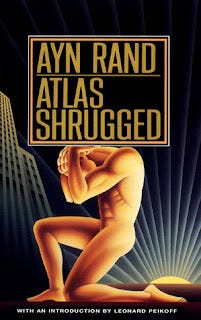
Atlas Shrugged
Ayn Rand
Better than I expected, but still not great
** Partial plot summary with spoilers follows **
I listened to the unabridged three-volume audible audiobook of Atlas Shrugged in the summer of 2005. It's LONG (Volume 1: 15h38m, Volume 2: 16h49m, Volume 3: 22h32m), and I listened to THE WHOLE THING, every single word. I was on a long road trip across the USA, driving all day and camping at night, and I listened as I drove. I remember that I began somewhere west of Texas and was still listening to it in Acadia National Park. (For those unfamiliar with US geography, that's a 2200 mile = 3600 km drive, if you follow the shortest road, which I did not.)
I was aware, of course, that Ayn Rand had the reputation of advocating naked capitalism, and Atlas Shrugged for glorifying selfishness. It is, furthermore, a book greatly admired by some political leaders in the USA (Ron Paul and Paul Ryan come to mind), and virtually worshipped by an army of fanboys and fangirls. It seemed, therefore, like something I ought to know more about.
Now, Rand thought herself a philosopher. I had the same problem I usually have when I read works by philosophers. Most philosophers begin by describing the work of past philosophers and explaining what is wrong with them. This part of the book is usually very convincing. Then the author expounds her own views, and it all falls apart. That was Atlas Shrugged in a nutshell. Since it was intended more as a work of political/economic/philosophical pedagogy than a novel, I expected Atlas Shrugged to be tedious. The story is often interrupted by long expository speeches, including the famous 60-page speech by John Galt, which carried me many hundreds of miles. (Possibly I am exaggerating -- it seemed like thousands.)
In fact, Atlas Shrugged was less tedious than I thought it would be. The story is told from the point of view of Dagny Taggart. Dagny runs a railroad company. She loves railroads and loves running a railroad company and doesn't care about the things a wealthy woman is supposed to care about. All my life I have been called weird because I like and do what I like, rather than what's expected of people like me. So I admired that about Dagny. However, it was obvious from the start that there are only three characters in Atlas Shrugged, whom I nicknamed Alpha, Beta, and Omega. Alpha is your Dagny Taggart, Hank Rearden, Francisco d'Anconia, and John Galt. (Each of the last three is, at one point or another, Dagny's lover, so Atlas Shrugged is a groundbreaking Reverse Harem novel!) Alpha is the mover and shaker, the great man and woman of industry. Beta is Alpha's worthy but less outstanding supporter. I no longer remember any of Beta's names. Omega is the taker, the worthless parasite. The most prominent of these is Dagny's despicable brother Jim Taggart, nominal head of Taggart Transcontinental, the railroad company that is de facto run by Dagny.
OK, so at the beginning we have an actual story with a plot and characters who are often interesting and sometimes admirable. It was when we got to Galt's Gulch that it all fell apart for me. Galt's Gulch is the capitalist utopia set up somewhere in the western USA, hidden by magical science-fiction technology Galt invented. Galt, Rearden, d'Anconia, and Dagny all live happily there with certain other Titans of Industry. Everything works, and everyone gets along. As I read this, I thought, "Ms Rand, have you ever met any real-life capitalists? [Surely she had, but one kinda doubts her powers of observation.] Have you, in fact, met Humans?"
Near the end of the book Dagny is kidnapped by a bunch of Bad People (probably under the direction of her brother Jim, though I no longer remember). Rearden, d'Anconia, and Galt turn into Tom Cruise action movie characters and rescue her. It's spectacularly stoopid.
Finally, no review of Atlas Shrugged would be complete without this bit of primo snark from John Rogers:
There are two novels that can change a bookish fourteen-year old’s life: The Lord of the Rings and Atlas Shrugged. One is a childish fantasy that often engenders a lifelong obsession with its unbelievable heroes, leading to an emotionally stunted, socially crippled adulthood, unable to deal with the real world. The other, of course, involves orcs.
An accurate description, in my assessment.