

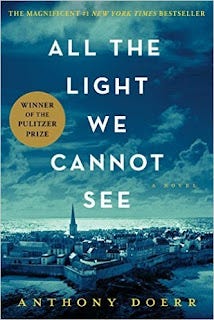
All the Light We Cannot See
Anthony Doerr
** spoiler alert **
Black knight rescues damsel in distress
Anthony Doerr's All the Light We Cannot See is a highly praised novel. It won a Pulitzer Prize and a Goodreads Choice Award, and also the coveted "My sister loved it!" award. I was therefore surprised when it turned out, in my estimation, to just be a fairly good World War II novel -- not a waste of my time by any means, but nothing extraordinary.
The two main characters of All the Light are a blind French girl, Marie-Laure LeBlanc, and a German radio technician Werner Pfennig. In 1940 Marie-Laure is a child of ten living in Paris with her very protective father. When the Nazis invade, they flee, eventually ending up in the Breton town of Saint-Malo, which is soon occupied by the Germans. Marie-Laure and her father live in her wealthy Great-Uncle Etienne's house.
We first meet Werner as an orphan in depressed pre-war Germany. It becomes apparent quickly that Werner is a genius. (Indeed, one chapter of All the Light is based on the story “He fixes radios by thinking!” told by bona fide physics genius Richard Feynman.) Werner escapes the orphanage to be educated in an elite army boys' school. There he helps develop a system for locating radio transmitters by triangulation. After his underage induction into the army, he travels through much of Europe putting this skill at the disposal of the army.
Marie-Laure and Werner suffer through the war until 1944, when, finally, the Allies invade France. The verb "suffer" is literal -- if you're familiar with the events of WWII, that will come as no surprise. By 1945 Saint-Malo is still held, just barely, by Germany. It has been shelled to near-total destruction by the Allies. At this point Marie-Laure's father and her great-uncle Etienne are German prisoners and Marie-Laure is alone in Etienne's house. She, like everyone in Saint-Malo, is in need of rescue. Werner is brought to Saint-Malo to locate a French Resistance radio transmitter.
Werner rescues Marie-Laure, helping her out of the city.
It's all very dramatic, not to mention cinematic. (In fact, the novel has been adapted as as Netflix TV series.) It doesn't break new ground. If you're a fan of historical fiction, you have read a whole bunch of wartime romance novels that have essentially this plot. Doerr is a more-than competent story-teller, and he makes a decent job of this one. I've left out a lot of cool plot embellishments to avoid spoiling. There is a possibly magic diamond called the Sea of Flames, and the Saint-Malo Resistance transmitter is operated by Etienne. Since Marie-Laure knows about it and helps, she is a criminal in German eyes.
My main problem with All the Light was Marie-Laure. She's basically your standard helpless damsel-in-distress, existing just to be rescued by a White Knight. I suspect that a lot of the love for the novel comes from its having a heroine who is blind. But I really, really disliked the way Doerr handled Marie-Laure's blindness. In his telling, it makes her helpless and takes away almost all her agency. (I'm being a little unfair here, but only a little, I think.) She really exists only to be a rescue target for Werner. Blind people I've met are not as helpless and isolated as Marie-Laure.
"But," you might object, "you are overlooking that Marie-Laure rescues Werner!" No, I am not. It is true that as a result of helping Marie-Laure, Werner is rescued from the moral trap he's in. But in truth, Marie-Laure's part in Werner's rescue is merely to be a pretty, helpless girl who excites his sympathy. Werner is the one who rescues Werner. Marie-Laure catalyzes his self-rescue by being adorable.
I'm being a bit hard on All the Light. But why not? I don't think I'm really being unfair. And it's not like my middling opinion is going to damage the reputation of a blockbuster like this.