

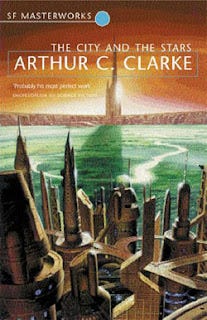
The City and the Stars
Arthur C Clarke
The book that convinced high-school me of Arthur C. Clarke’s genius
The City and the Stars was arguably Arthur C. Clarke's first novel. Although it came out in 1956, by which time Clarke had published several other novels, The City and the Stars is an expanded version of the novella Against the Fall of Night, Clarke's first published book, which came out in 1948. "The City" is Diaspar, an isolated, entirely automated city run by an artificial intelligence that is much less stupid than the fictional AIs of that time generally were. (As late as 1970, a science fiction artificial intelligence could be frozen into immobility by telling it, "Everything I say is a lie." Clarke actually makes fun of this in a subtle way, that you will probably miss if you don't know what it refers to.) The inhabitants of Diaspar are essentially immortal humans who spend most of the time in the memory banks of this AI, but come out to inhabit bodies and play now and then.
The hero of The City and the Stars is Alvin. He is a "Unique", meaning that he is a newborn who has never before had a body. He turns out to have special powers over Diaspar. It would be a spoiler to say much more than that. I have to admit that much of the appeal of The City and the Stars to high school me came from the fact that Alvin was special, and I, like many high school kids, also imagined myself to be special.
Still, this was clearly the most intelligent science fiction I had read until that time (around 1970, at a guess). It is, I think, even better than Childhood's End, which some considered to be Clarke's greatest novel.