

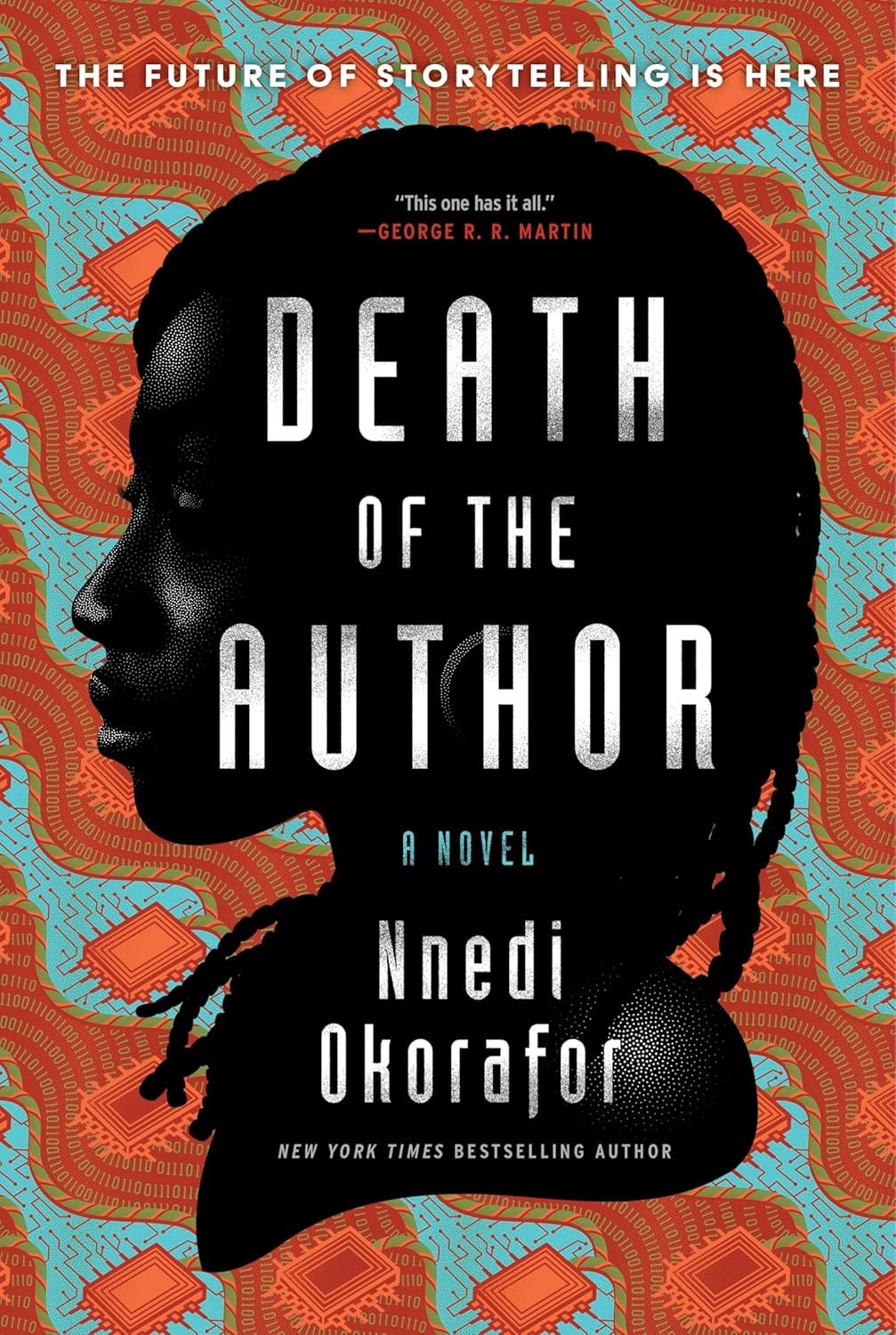
Death of the Author
Nnedi Okorafor
Friction, friction, friction
Here are the finalists for the 2026 Best Novel Hugo Award:
★★★★★ A Drop of Corruption by Robert Jackson Bennett
★★★☆☆ Death of the Author by Nnedi Okorafor
☆☆☆☆☆ Shroud by Adrian Tchaikovsky
★★★★★ The Everlasting by Alix E. Harrow
☆☆☆☆☆ The Incandescent by Emily Tesh
★★★★★ The Raven Scholar by Antonia Hodgson
Neuroscientists and psychologists who study it will tell you that reading is a profoundly unnatural activity, one that the brains of our ancestors schlepping around the plains of Africa were not adapted for. It is therefore not surprising that so many children find it hard to learn to read. Now, if you're reading this review, it is likely that you have trained yourself to read so well that it feels natural to you.
Yet, I'll bet that every now and then you read a book that reminds you that reading is unnatural, a book that feels like hard work to read. Sadly, for me Nnedi Okorafor's novels are all like that. I can admire them intellectually -- I can say to myself as I read, "Well, that's clever... That was well done..." What I cannot do is enjoy them. It's not a thing I'm proud of. It is better to be a person who enjoys books than one who doesn't, and I think I have a talent for enjoying books -- I can read almost anything with pleasure. Okorafor defeats me.
The protagonist, Zelu, (Zelunjo Onyenezi-Oyedele) is a paraplegic Naijamerican (Nigerian-American) author. She has written a novel that she was unable to get published. She makes a little money as an adjunct professor, but she's a lousy teacher and gets fired just as the novel begins. She has an abrasive personality. She belongs to a large Naijamerican family who get angry with her whenever she fails to follow the constrained script they have written for her, as a disabled person. (Nigerian attitudes towards disabled persons, which the novel explores, are not kind.)
Then, just when her life is at its worst, she writes a science fiction novel, something she had never thought of doing before. It is a huge success. A movie is, made, and she becomes wealthy. Other ostensibly interesting things happen to her, which, to avoid spoiling, I will not describe. All through this narrative Okorafor lobs in hints, subtle as mortar rounds, that Zelu's tale is going to culminate in some remarkable way. (The title, by the way, refers to a famous essay on literary criticism by Roland Barthes and not necessarily to the literal death of this particular author.)
Now, I can love a character who is objectively unloveable. I am very fond of Holden Caulfield, even though he's a liar and a creep and would be personally unendurable. I cannot love Zelu, or her family. My life would be brighter if they had never cast their shadows on me. It was a struggle to force myself to keep reading about these people and their repeated foolish, foolish behavior. As usual with Okorafor, there is much here that I can admire intellectually. But I would have had more fun reading an accounting textbook. (Not hyperbole.)
I can't recommend this one at all.