

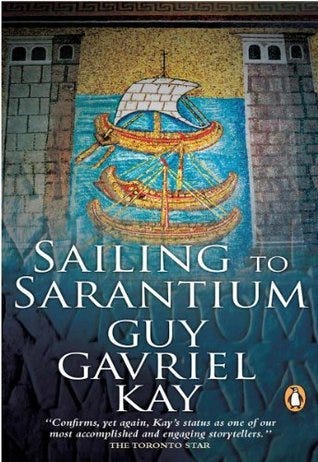
Sailing to Sarantium
Guy Gavriel Kay
Decorating the Hagia Sophia
According to Wikipedia, Sailing to Sarantium is Guy Gavriel Kay's seventh published novel. By this time GGK had found his "quarter turn to the fantastic" groove. Roughly, that means that he writes historical fiction with all the names and also a few historical events changed. Put baldly like that, it sounds awful. He has written persuasively about why he chooses to do this. I doubt it would work as well for other historical fiction novelists, but it definitely works for GGK.
In GGK's alternative history world, Constantinople (modern Istanbul, as They Might Be Giants remind us) is called Sarantium and is the capital of the Eastern Rhodian Empire. The old Rhodian Empire was centered in Rhodias on the Batiaran peninsula. Obviously Rhodias corresponds to Rome and Batiara to Italy (without the elegant shape of a boot kicking a Sicilian football).
I had thought that a book entitled Sailing to Sarantium would be a story about someone actually sailing to Sarantium. It is not. The title is metaphorical. "To say of a man that he was sailing to Sarantium was to say that his life was on the cusp of change: poised for emergent greatness, brilliance, fortune—or else at the very precipice of a final and absolute fall as he met something too vast for his capacity." In contrast, the series title the Sarantine Mosaic, which I thought metaphor, is meant literally. Emperor Valerius II is building a huge cathedral in Sarantium. (This cathedral obviously corresponds to the Hagia Sophia.) Valerius sends to Batiara to recruit a Rhodian mosaicist to decorate his new cathedral.
This mosaicist, Caius Crispus (Crispin), is the central character of Sailing to Sarantium. He undertakes the dangerous journey from Batiara to Sarantium. Exciting things happen to him, that I won't spoil. It's a good story.
As in many of GGK's works, there is a light fantasy element to Sailing to Sarantium. The supernatural is not central to the story. It could have been told with little change without magic. But it would not have been as good a story, and Crispin's character would be diminished without the magic.
I am looking forward to the second novel, Lord of Emperors.
I read Sailing to Sarantium shortly after finishing Kierstin White's Conqueror's Saga, which also spends a lot of time in Constaninople, much later in its history, and they work well together.
https://www.goodreads.com/series/191449-the-conqueror-s-saga