

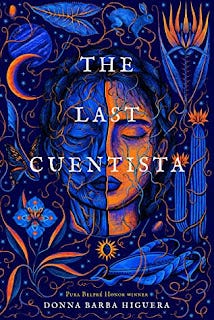
The Last Cuentista
Donna Barba Higuera
The Earth destroyed and stories saved
Apparently Comet Halley and Earth are due to meet on a very bad date in 2061. The premise of The Last Cuentista ("cuentista" is "storyteller" in Spanish) is that a solar flare will knock Halley off course enough to make it collide with Earth. (This is, of course, ludicrously implausible, but it doesn't really matter. More plausible astronomical catastrophes can easily be imagined, so just take it as read that it was one of those and don't get hung up on poor Halley.) Most of Earth's population is doomed, and there is essentially nothing that can be done to save them.
However, it transpires that by 2061 we have a few starships built and just about ready to launch. (By the way, if this all sounds spoilery, look at the publisher's blurb -- you'll see I'm giving nothing essential away that the publishers didn't already reveal.) Petra's family, the Peñas, is one of the lucky few chosen to board a starship and make the several-hundred-year journey to a new planet. The bad news (what, a comet collision wasn't already bad news?) is that on the starship are a bunch of quasi-religious nutcases called the Collective who believe the comet is an ideal opportunity for humankind to start afresh. The Collective takes over the starship and erases everyone's memories.
Everyone's except Petra's. Petra is thus the last carrier of humanity's memories on the ship. Petra always wanted to be a cuentista like her beloved abuelita (Spanish for grandmother).
So, there are two linked stories in The Last Cuentista. The first is a science fiction adventure plot, about which I will say no more to avoid spoilers. The second is about Petra's becoming a storyteller.
The Last Cuentista reminded me of another Newbery medal winner, Tae Keller's When You Trap a Tiger. There, instead of the hokey science fiction plot (don't get me wrong -- I'm a huge SF fan!) we have a rather ordinary life problem that the narrator, Lily, tries to solve by storytelling. There's also a similar exotic feel, in that Lily's stories are modeled after traditional Korean folklore, while Petra's are modeled after Mexican folklore. I didn't feel The Last Cuentista worked quite as well as When You Trap a Tiger, however.