

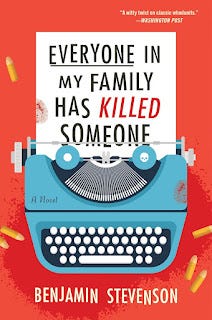
Everyone In My Family Has Killed Someone
Benjamin Stevenson
An examination of mystery fiction
My title for this review makes it sound like Benjamin Stevenson's Everyone in My Family Has Killed Someone is an academic work on mystery fiction. It is not. It is, in fact, a murder mystery. The title choice was deliberate, though, because at times it feels very academic. Our hero, Ernest Cunningham, is an author who writes HOWTO books for would-be mystery writers. That is, he writes short little self-published eBooks that go for $1.99. The book in fact ends with an advertisement for two of these books: 10 Easy Steps to Write Crime Like You Lived in the 1930s and Golden Age to Your Golden Page: How to Write a Mystery. They don't exist, of course.
Murder mysteries are like sonnets or haiku -- a defined literary form with specific and somewhat arbitrary rules that writers are supposed to follow. Ernest Cunningham of course, knows all these rules, and he is very explicit about what they are and how he is being careful to follow them.
Now, time for a confession. I am not really a mystery fan. I read some mysteries with pleasure, but I don't read them as mysteries -- I read them the way I read other novels, for story and character. I'm not really interested in trying to figure out the puzzle for myself. (That's what most of the mystery rules are about -- they're intended to make the game the reader is presumed to be playing with the author a fair one.) I think this is because I was really an investigator -- not an investigator of crimes, but an experimental biologist. And the artificiality of the murder mystery genre puts me off. Now, if you're a real mystery fan, good for you! I enjoy sonnets, too, haiku, less. I have just never been willing to do the work it would take to be a serious mystery fan.
Still, some murder mysteries are good literature. My favorites might be the Navajo mysteries by Tony and Anne Hillerman.
This one, alas, is never gonna be one of my favorites. I'm just not willing to work hard enough to follow it. For instance, Ernie tells us early in the book the numbers of the chapters in which a death takes place. He expects (or pretends to expect) his readers to know when a death is imminent, based on this list. I didn't memorize the list of death chapters or note it down anywhere. Nor did I pay close attention to any of the other rules Ernie was being so careful about.
That meant that the story kind of got lost in the pseudo-academic minutia. None of the characters really came into focus for me, not even Ernie.
Now, if you ARE a serious mystery fan, you might enjoy this a lot. It is undoubtedly clever.