

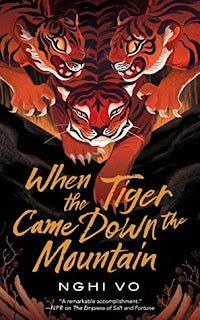
When the Tiger Came Down the Mountain
Nghi Vo
Fear and Love and Being Eaten
Like The Empress of Salt and Fortune, When the Tiger Came Down the Mountain is a framework story. It is told by our old friend Chih, the Singing Hills cleric from Empress, with the assistance of some members of his audience. (You may be disappointed to learn that Chih's neixin Almost Brilliant had to sit this one out, due to other obligations.) Although Nghi Vo once again plays with story-telling technique in When the Tiger, it is more straightforwardly told and easier to follow from the start.
It begins when Chih begs a mammoth ride from scout Si-yu. They are pursued by three hungry tigers but manage to get to shelter before the tigers catch them. To stall the tigers, Chih begins to tell them a traditional story of matriarch tiger Ho Thi Thao and her courtship of the scholar Dieu. Ho Thi Thao is "the tiger who came down the mountain" referred to in the title. The tigers warn Chih that if Chih tells the story wrong there will be consequences (they will eat them immediately). Chih asks to be corrected if they get anything wrong.
The story is thus told with frequent interruptions and corrections. Vo has written (see her kindle notes on Empress),
I think that we put ourselves into the stories we tell. You can't separate a story from the teller, ...
Much of the magic of When the Tiger is the way that the story changes when the tigers tell it. I preferred the tiger version of the story. Ho Thi Thao is a tiger, after all, and it is not surprising that tigers would have better insights into her motives and thoughts than humans.
Also magical was the poetry with which the love story is told. And it was exciting -- there's a lot more action in When the Tiger.
Like Empress, When the Tiger is a quick read. It took me about 90 min.
I recently read a review that ended, "Read it. You won't regret it." It's a stupid thing to write. There is no book that everyone will love. If no one hates it, it isn't great art. I think When the Tiger is great art, and therefore I will warn you that, although I loved it, you may hate it.
Small note: I recently read A Snake Falls to Earth by Lipan Apache author Darcie Little Badger. On reading When the Tiger I was surprised to see how similar the depiction of animal persons is in Vo's Chinese/Vietnamese and Little Badger's Apache folklore. I guess talking humanoid animals are just a folklore universal. (Even C.S. Lewis couldn't resist their allure in Narnia.)