

Fay and Sudden and Unholy
Epigraph
S. Patrick. You who are bent, and bald, and blind,
With a heavy heart and a wandering mind,
Have known three centuries, poets sing,
Of dalliance with a demon thing.
— “The Wanderings of Oisin, Part 1”, by WB Yeats
Fay and Sudden and Unholy
Cold rain ran over Patrick’s face. The date lacked four days of the spring equinox. His threescore and ten years had already passed. He was an old blockhead to stand in the cold winter rain. Yet he had lived no easy life—he counted himself a hard man still.
There was … a thing … in the dark rain. He stood before a huge old willow. The rain poured through the willow into a solid shape. It took the form of a woman, slender, short-haired, clothed in blue. She glowed, like one of God’s own saints. Rain streamed from her in silver sparks.
“Woman! What are you!” he shouted.
“I am sister to the rain,
Fay and sudden and unholy,” a voice intoned.
“But what are you?” Patrick demanded again.
“You once named me ‘a demon thing.’”
“Woman, I did not,” Patrick answered. “I do not know you.”
“We have never before met, Adze-Head.”
The druids had been wont to mock him thus. “You are a druid?” he asked.
“I was old already when druids were a new thing,” she said.
“Tell me your name,” Patrick demanded.
“I am Niamh,” she answered.
“Niamh.” He had indeed heard that name. Who had said it? Then he remembered—that old heathen Oisín.
“Was it you who beguiled the old fool Oisín?”
“I was his wife, and he the father of my children.”
“He was a rake, and you his drab. Your union with Oisín was not sanctioned by Holy Church. You were sinners.”
“You are well-named, Adze-Head.”
“My name is Patrick, Thing.”
“I will not name you Patricius. My husband Oisín was a father. You have never been one.” She held out a jeweled casket. “I have preserved Oisín’s life with me in this casket. Shall I give you Oisín’s life and fatherhood?”
Patrick’s pride was stung by her words. And his curiosity was aroused. What devil’s trick could be in this box? Patrick shrugged.
Niamh opened it.
Looking into the open compartment, Patrick’s sense was swept away. He was young again and strong. He rode on a great white horse. He sat before the demon-woman, Niamh, held in her arms. The horse galloped over the sea, pacing the water as easily as if it were a grassy plain.
…
They came to a fair land named Tír na nÓg. It was inhabited by fay and elves. Patrick played his harp for a company of fay. They begged him to stop this music too sad to bear.
…
Patrick lay in Niamh’s naked arms, dizzy with love. She bore him three children, Oscar, Plor na mBan, and Finn.
They lived long years in Tír na nÓg. Together they loved and raised the children. As children will, theirs left. No word came back.
Patrick ached to know what their children became.
…
Asleep with Niamh, Patrick dreamed he stood in a moonlit meadow. A starling, weak from long miles of flight, alighted in the meadow. The starling brought memories of hunts with the Fianna, and the great men he had known. His own father Fionn Mac Cumaill was first among them.
He grieved for his old life with the Fian.
Knowing what he wanted, the great white horse came to him. Niamh, waking, grew pale as the whitest pearl.
“Niamh,” he called. “The longing is on me. I must see my old comrades once more.”
“They are no more, my love. If you go now I may never see you again.”
Patrick rode alone over the waves, leaving Niamh behind.
“Is there no more, Thing?” Patrick said to Niamh. “Oisín returned to Ireland. He was bent and old. I met him. He told me his story. I exhorted him to repent. He refused God. He burns in Hell now.”
“I can show you no more. This box is mine. It captured only that part of Oisín’s life he shared with me. He never returned after my white horse bore him away. I shared with you all I have of Oisín.”
“But what of our children—that is to say, your children?”
“I never heard more of them. You, Adze-Head, were the last to speak with Oisín.”
“I knew him a creeping old man, full of sleep, with little life left to live. Three hundred years had passed since he was born of Fionn Mac Cumaill and Sadhbh.”
“I gave you Oisín’s life, his three hundred years with me. He lived those years with me in Tír na nÓg, where all are young. Here in Ireland men become old.”
A weakness passed over Patrick. His vision and memory faded. His heart squeezed painfully in his chest. Was this grief at the passing of the children, or something more?
“I die!” he cried and fell at Niamh’s feet.
Afterword
This story began when I read the story of Oisín and Niamh as told by WB Yeats in his poem “The Wanderings of Oisín.” About the same time I happened to reread Dorothy Parker’s poem “Rainy Night,” (an old favorite), and I imagined Niamh singing its words as an incantation. I used two lines in the story
I am sister to the rain;
Fey and sudden and unholy,
…although I altered “fey” to “fay” to better fit the story.
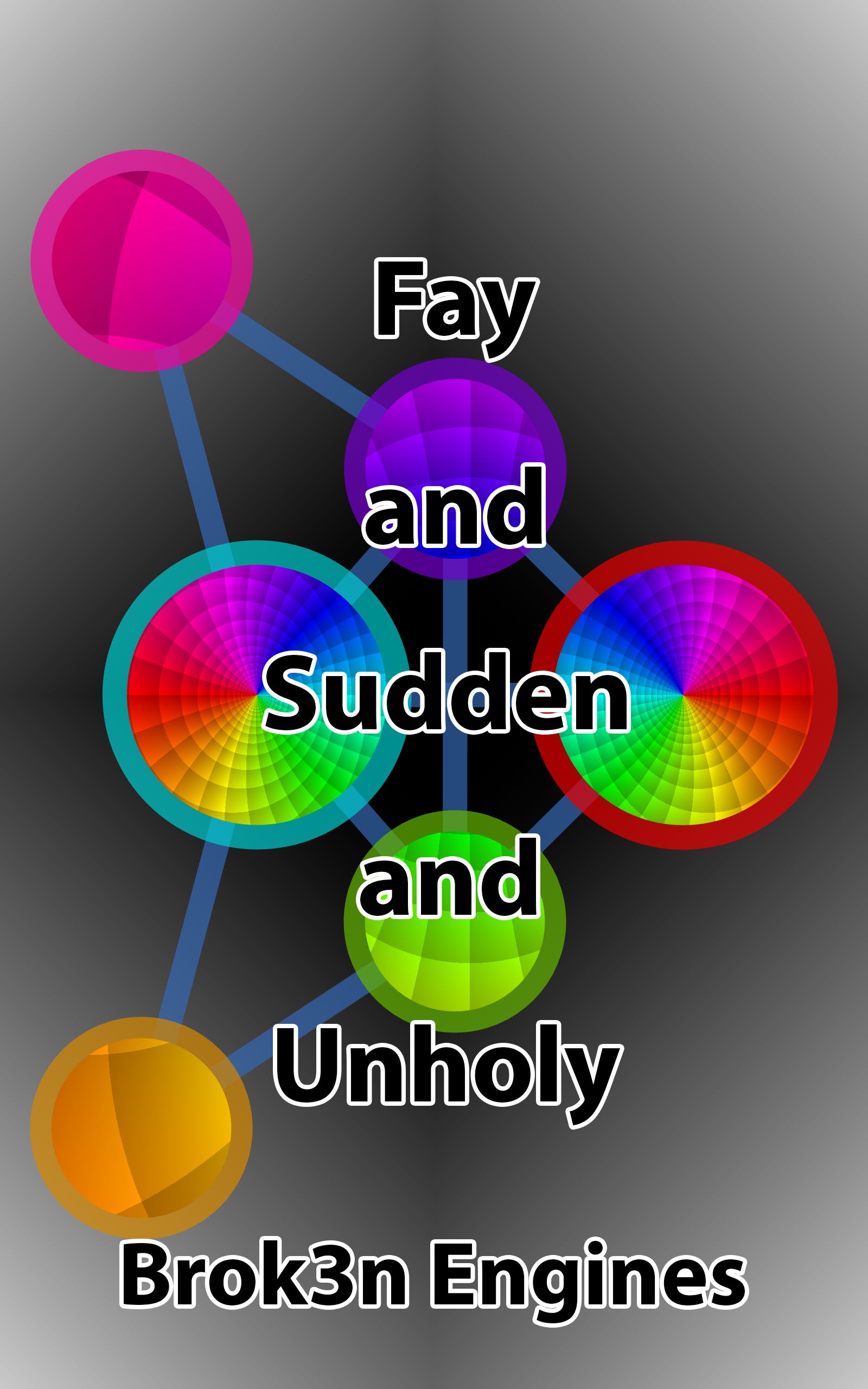
The cover is a cycle graph of the cyclic group Z6, meant here to stand for Niamh, Patrick, Oisín, Oscar, Plor na mBan, and Finn. The colors are based on a phase portrait of

Where niamh and patrick are the centers of the corresponding graph vertexes.
Haunted
After seeing this music video, it became impossible to imagine Niamh as anyone other than Sinead O’Conner. It is true that she is traditionally known as Niamh Cinn-Óir, Golden-haired Niamh. But she is Fay—surely her appearance is a glamour that she can change at will.
This was so fascinating to read. Genuinly love unique work like this!
I loved how Patrick briefly called them “our children.” a small detail which made the sadness feel so real. Beautifully written 🩵