

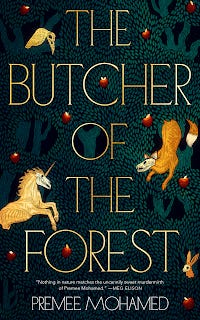
Butcher of the Forest
Premee Mohamed
The fluid boundary between mystery and puzzle
Veris lives near an enchanted forest, the Elmever. Children who get lost in the forest never come out. People of the villages have learned to mourn those who go lost in the wood as if they were dead, for those who enter the forest to search for their lost children also never come out. With one exception: Veris herself once went into the forest to search for a child and returned with the child. That was years ago.
The Tyrant who rules over the country where Veris lives has two children. Last night they snuck out of the castle and went into the forest, looking for adventure, probably. The Tyrant has Veris brought to him and tells her
“You are to go into the woods again, and recover my children.”
He will kill her family and raze her village if she fails. He is a cruel man who has done such things for far less reason in the past.
Veris walks into the forest. This description intrigued me:
Really, the problem was that people believed that there was some kind of . . . door, or gate, or at any rate some visible thing that let you enter the Elmever, and it was thought that this lured children in some way, tempted them with sparkle or song to step through it.
The truth was much more dangerous, Veris knew. For the world of those others was not at all through a doorway that alerted you to its presence, but was instead adjacent to the real one in a way that could not be perceived by human senses, and that was precisely why people went missing into it. At some point, you took a step, and you were simply there, and you would not see the difference between it and the true woods, and you would never take another step that led you back home.
There are two kinds of questions that are hard to answer -- more, really, but we start with these two: mysteries and puzzles. It has been pointed out (by Malcolm Gladwell, among others) that these are different things. A puzzle has a right answer. A mystery does not -- it is an unknowable thing. But if you know anything of the history of ideas, you know that sometimes puzzles become mysteries and mysteries puzzles. Sometimes you have to find a different way of knowing. (The history of mathematics is full of examples.)
Here is the story as I saw it: to bring the children out, Veris must make puzzles of some of the mysteries of the Elmever. Although I doubt it is what Premee Mohamed had in mind, her description "At some point, you took a step, and you were simply there, and you would not see the difference between it and the true woods" felt to me like the imperceptible slip from puzzles -- things unknown -- to mysteries -- things unknowable. And to return Veris must do the opposite -- move from mystery to puzzle.
The actual story of what happens to Veris in the Elmever is far more concrete than that abstract question makes it sound. In fact, Veris meets things and fights things and talks to things and makes bargains. It becomes clear as the story progresses that we will not understand what Veris is doing unless we also know the story of her past foray into the forest, why she went, who she was pursuing, how she succeeded and how she failed. We do eventually learn these things.
I was left with a puzzle, and this is definitely a puzzle rather than a mystery: why is the book called Butcher of the Forest? Nothing that Veris encounters in the forest is referred to as a butcher, nor does anything obviously merit that description. I am left puzzled as to where the title of the book comes from. I am pretty sure Mohamed knows why she called it that, but I am clueless.
I really enjoyed this. It was not like anything I had read before. It is just the right kind of weird. Different readers will see different things in it.
I thank NetGalley and Tordotcom for an advance reader copy of Butcher of the Forest. This review expresses my honest opinions.