

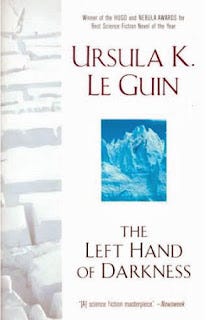
The Left Hand of Darkness
Ursula K Le Guin
A friendship
In 1975 Ursula K. Le Guin won both the Hugo and the Nebula for best novel for The Dispossessed. This was by no means the first time the same book had won both the Hugo and the Nebula. However, Le Guin had accomplished the same feat once before, in 1970 with The Left Hand of Darkness. As far as I knew at the time, she was the only author to have done this twice. (Arthur C. Clarke also did it, but later.) Therefore I read The Left Hand of Darkness and The Dispossessed, and subsequently everything by Le Guin I could get my hands on.
Here is how The Left Hand of Darkness begins,
The soundest fact may fail or prevail in the style of its telling: like that singular organic jewel of our seas, which grows brighter as one woman wears it and, worn by another, dulls and goes to dust.
Now, if you've read a lot of science fiction, that sentence at first looks familiar: Science Fiction authors are always making up weird implausible things from other planets and exploiting them in unearned metaphors. It's cheap and annoying. So, that was my first reaction. Then I thought, "Wait... Organic jewel, seas, she's talking about pearls!" It was a brilliant stranger-than-fiction moment. These thoughts had just time to chase themselves through my brain before I read the leaden next sentence, "Facts are no more solid, coherent, round, and real than pearls are." So, that's Ursula K. Le Guin for you -- she can be brilliant, subtle, demanding, but also in the next breath sledgehammer obvious and sanctimonious.
The Left Hand of Darkness is the story of a man from Earth, Genly Ai, sent as an envoy to the planet Winter, to invite/negotiate their joining the multiworld community Genly represents. As you will know from the publisher's blurb, the people of Winter are human, but they are hermaphrodites. This is the gimmick of The Left Hand of Darkness, and I confess, it didn't much interest me in itself. It was a cultural (also biological, but in my opinion the cultural difference is more important) thing that made it difficult for Genly and Estraven to connect -- it really could have been anything. Indeed, there are other cultural differences that are more important, particularly Karhidish conventions about giving advice.
Estraven? Who is that? Estraven is a nobleman of Karhide, one of the nations on Winter. Estraven's nobility is not merely a matter of social rank -- he is truly a noble person. (I say "he" because throughout The Left Hand of Darkness the people of Winter are referred to with masculine pronouns. In the Zeitgeist of the time this choice was more obvious than it seems now. Le Guin later expressed some regret about it, and indeed wrote at least one story about Karhide using feminine pronouns.)
So, naturally Genly finds himself immersed in a political conflict that he completely fails to understand. Estraven, a powerful Karhidish politician, favors Genly's mission. But Estraven equally fails to understand Genly.
Nevertheless they become friends. For me that is the heart of the novel -- Genly and Estraven's friendship. The Left Hand of Darkness is not what we usually call a love story, but nevertheless Genly and Estraven come to love and understand each other, and even to be intimate, though the intimacy is entirely intellectual.