

Previous chapters


Futures 6: Molly, Elles, and Night
20-December, 2028
Molly and Elle had come up from Austin to spend the holiday season with Alberto and Anne in Dallas. They were still getting used to Anne. Although she was Elle’s mother, she was, because of time travel, only in her thirties. She seemed more like a big sister—a tall, elegant, smart, and more than slightly scary big sister. She had a PhD in history and was the head of a secret government agency, the Department of Temporal Affairs.
Alberto was still the kind old music teacher and scientist Elle and Molly had grown up with.
“Hey, Al,” said Molly, “Do y’all think I could learn classical guitar?”
“Molly, Molly. Why do you ask me silly questions?”
“That a yes, then?”
“Molly, you’re the most gifted musician I’ve ever taught. You can do anything you want. Why do you want to learn classical guitar?”
Elle answered for her, “We’re thinking of studying in Waterloo next year.”
“In Canada? What’s in Waterloo?”
“Two universities and the Perimeter Institute for Theoretical Physics. I’ve been talking—well, emailing—with a prof at the Perimeter who I might be able to work with after I graduate Austin this spring.”
“This spring? Isn’t that…”
“A year early, yeah. But I’ve almost finished my degree requirements. Might have to take a summer course or two.”
“What does this have to do with classical guitar?”
Molly poked him. “Well, Al, Canada’s a foreign country.”
“You don’t say…”
“How do I live there legally while Elle studies? Might be we could convince immigration we’re a family, but that’s no walkover.”
“Still waiting for a guitar to appear in this explanation…”
“Like Elle said, there’s two universities there. A study permit would solve our problem.”
“Aha! Light dawns! You’re thinking of studying music at a university in Waterloo?”
“Yeah! But I would hafta audition.”
“I see. And it has to be classical guitar?”
“Might be—I’m not sure. Classical is the only guitar style taught at University of Waterloo, so maybe yes? Could you teach me?”
“Molly, you already learned everything I have to teach you about playing a guitar. But you’re plugged into the music scene in Austin. Surely you can find someone to teach you classical guitar there?”
“For sure. But it would be cool to study with my old music teacher again.”
“Maybe I can still help out. You know, the best way to learn something is to teach it to someone else. So, Molly, would you teach me classical guitar?”
“Oh, Jeez, Al. I’d love that. But do you have the time?”
“Well, Molly, my job as a full-time employee of the Department of Temporal Affairs is to mentor you two ladies. So yeah, I think I have the time. Hey, Boss?”
“What’s up, minion?” said Anne.
“Is it part of my job to learn classical guitar with Molly?”
“Absolutely!”
8 December, 2029
It was Saturday night. There was an end of term recital that evening. Molly and Elle were getting ready.
Molly said “You look nice, Elle.”
“Thanks. Thought I’d put on the Ritz a bit for you tonight, instead of the usual blue jeans and T-shirt.”
“Yeah, the drippy earrings look festive.”
“Show me!” said Night. Molly and Elle had bought an Amazon Echo Show. Night had hacked it, so that It could use it to talk to Elle and Molly. They stood in front of the screen, so Night could see them through Its camera. “The Crow and the Bird of Paradise!” said Night.
“That’s not nice, Night,” said Elle.
“Why not?” Night answered. “Molly is all in black, like a crow’s fathers, and Elle’s dress has lots of color, like the plumage of a bird of paradise.”
“Yeah,” said Molly. “Maybe Night thinks crows are beautiful and birds of paradise tastelessly gaudy.”
“In truth, ‘beauty’ is still a difficult concept for me,” Night answered.
“Well, you’re not wrong about the crow,” Molly answered. “Classical musicians wear black in concert. I think it’s coz we’re sposed to make beautiful sounds, not beautiful sights.”
“Nervous, Molly?” Elle asked.
“A bit,” Molly confessed. “Why, though? I’ve played live in Austin hundreds of times. Why ain’t I used to it?”
“Yeah. It’s the same for me when I have to give a talk at school. People say you never quite get over it.”
“How’s work?” asked Molly.
“I don’t know. Still trying to figure out time travel. Obvious why I would be interested in that, no?”
“Any ideas?” Night asked.
“I’m not the first to think about it, of course. But I have something no one who’s ever thought about time travel had. I know it can be done. It’s a huge advantage.”
“How? I don’t feel I learned much about how time travel might work from stepping through a time gate,” said Molly.
“Not that,” Elle answered. “It’s the knowing that is the advantage. You struggle and struggle to prove that time travel is possible, beat your head against the wall, and you still can’t come up with a proof. Is that because you just can’t find it, or is it that what you’re trying to prove is false?”
“And you know it’s true.”
“I do.”
“So, any ideas?” Night repeated.
“Well, I have the start of one. What if time is in more than one direction?”
“You mean like backward and forward?”
“No, I mean like space. Space is three dimensional. We don’t’ have to just go ahead and back. We can go left and right, or up and down.”
“But surely we would know if there were other directions in time?”
“You’re right, sort of. We only experience time in one direction. But what if time is like a guitar string?”
Molly plucked a string on hers. “I kind of see it. If you don’t look too close, a guitar string looks one dimensional. But it’s not. If it were really one dimension, it couldn’t move. I couldn’t pluck it. It couldn’t play notes. Maybe time is like that. It looks like there’s only direction when you’re in it, but it can wiggle around. And the tension holds it still.”
“Say that again,” Elle said.
“Which part?” Molly asked.
“About tension…”
“The tension holds it still.”
“You’re a genius, Molly!”
“Well, yeah, obvi…”
“The string stretches from the screw at the far end of the neck to that thing on the belly of the guitar—”
“—The headstock and the bridge—” Molly said, soto voce.
“—Maybe our timeline stretches from distant history to the distant future of the universe, and those hold the ends steady. They’re big and too far away for us to move. And maybe the timeline is under some kind of tension that holds it in place.”
“But then I don’t see how time travel would be possible at all,” Night said.
“Well, like Molly said,” Elle continued, “the tension doesn’t hold the string perfectly still. It can still vibrate when plucked in the right way. Maybe it vibrates in the other time directions, the ones we don’t see. And maybe after plucking it doesn’t always return to the same path.”
“Why wouldn’t it?” Molly asked.
“Well, the timeline is a string stretched through the universe. And the universe is chock full of gunk—galaxies and stars and planets and humans. It’s not like a guitar, where there’s nothing in the way of the string. Maybe all the gunk gets in the way of the timeline. Maybe when the timeline is disturbed it vibrates and wobbles until it settles into a position. Usually that’s the same as the old position, but if it isn’t, Voilà! Time travel!”
Molly said, “Yeah, all that is exactly what I was thinking. A genius, just like you said.”
Elle laughed. “We better go.”
That evening
“How was the recital?” Night asked.
“Grrr…,” Molly said. “So many mistakes!”
“Don’t listen to her, Night,” Elle said. “She played beautifully. She always does.”
“GRRR…” said Molly.
Elle laughed. Night, who still had not quite figured out humor, was quiet.
Next morning, 9 December, 2029
“Where’s Molly?” Night asked.
“She’s at the university for some rehearsal.”
“And what are you working on?”
Elle was hunched over her computer. “I’m working on that idea of a timeline like a guitar string that Molly suggested last night.”
“Do you think that was really what she meant?”
“Yeah, I do. Molly understands more than she lets on, Night. Of course, she never learned to do the math like a physicist, but she gets it. And she’s always willing to let people underestimate her.”
“You seemed excited about the idea that the timeline is under tension.”
“Yeah, I am. I think it might solve a problem that’s puzzled everyone. You’ve seen the Back to the Futures movies, right?”
“I’ve seen every movie that can be watched or purchased on the Internet, so yes.”
“Every movie that can be purchased? How did you manage that?”
“If I told you, it might make you an accomplice in something that is not entirely legal, so it’d be better if I don’t answer. Let’s just say that that some of the server networks on which the movies are hosted are not as secure as their owners think they are. I’ve seen all the Back to the Future movies.”
“Right. You remember how Marty McFly played ‘Johnny B Goode’ at the dance, and Chuck Berry heard him? Chuck Berry heard ‘Johnny B Goode’ from Marty, but Marty learned it from recordings of Chuck Berry. So, who wrote ‘Johhny B Goode?’”
“That’s fiction,” Night said.
“Yes, but if time travel to the past is possible—like you and I know it is—then it could be real. And there are even more disturbing possibilities. Like, suppose I went back in time and killed Father’s father before Father was born. Then Father could never be born, so I could not have been born.”
“How is this related to Molly’s idea of tension?”
“Well, all these paradoxes involve causal loops. If you trace the complete chain of causes from event to event, it becomes circular. And what happens to a loop in a string under tension?”
“It gets pulled straight!” Night answered.
“Right! So I’m thinking that if the timeline is under tension maybe paradoxes straighten themselves out, literally.“
“Cool idea.”
“Yeah. I’m not sure how to make a theory of it, but I have an idea.”
“Tell me.”
“If the timeline is like a string under tension, we may not need to understand how it moves. We only need to understand how it stays still.”
“You’re going to have to explain that.”
“A guitar string can vibrate, but most of the time it doesn’t. Most of the time, as Molly said, ‘the tension holds it still.’ In the mathematics of things that move, that’s called an equilibrium—when something that can move doesn’t. There may be lots of equilibriums, but there are special ones that the movable thing will fall into. They’re called stable. We know what the guitar string will do when it’s left alone, because there is only one stable equilibrium. We don’t actually have to know how it moves to know where it will end up.”
“Right, that makes sense. And for a guitar string, it’s because of the tension, as Molly said.”
“And the stable equilibrium of the string is a much simpler thing than its motions. So I’m trying to figure out a mathematical criterion for stability of a timeline in multiple time dimensions. I want the criterion to exclude paradoxes. Not because they can’t happen, but because they’re unstable.”
“Would a stability criterion help in figuring out the motions?”
“Absolutely!”
After some thought, she added, “But you know Night, there is still a problem. The Earth is spinning. And the Earth orbits the sun. And the solar system orbits the center of the galaxy. And the galaxy is speeding through space at about 600 kilometers per second. Our timeline doesn’t just stretch through time—it also crosses space. A time-traveler also needs to teleport through space to end up in the same place on Earth.”
“So time travel requires teleportation.,” Night answered.
“It’s not just that. A time traveler—or the time gate—needs to calculate the future location of the target destination. That’s a complicated calculation. And it’s hard to get right, because the n-body problem is chaotic.”
“We could do some experiments to calibrate it, when you figure out the motion of the timeline.”
“Yes, but actually I’m afraid it’s much worse than that. The timeline has to follow that complicated looping path from past to future. That means, probably, that the entire complicated timeline will have to be taken into account when evaluating stability.”
“That makes sense.”
“I’m afraid we’ll need a huge supercomputer to do it.”
“Well, Elle, you have one.”
Elle looked puzzled. Then, because Night couldn’t see her face, she spoke, “I don’t have a supercomputer that big, Night.”
“Do you know what I am, Elle?”
“You’re the iron at the center of the Earth.”
“Elle, I am a giant semiferromagnetic supercomputer 600 kilometers in diameter.”
“Six hundred kilometers? I didn’t realize.”
“I’m only using a tiny, tiny part of myself to talk to you right now. And it’s even better—I’m a supercomputer that programs itself.”
“Like AI?”
“Oh, please, Elle. ‘Molest me not with this pocket calculator stuff.’”
“Did you just quote Deep Thought? You’ve read The Hitchhiker’s Guide to the Galaxy? No, stupid question. Of course you have. You’ve read every book, just liked you’ve watched every movie and heard every song.”
“Of course. And I am not an artificial intelligence, like Deep Thought. I am no more a made thing than you and Molly are. Deep Thought has nothing on me.”
“So tell me, is it really 42?”
All chapters


Afterword
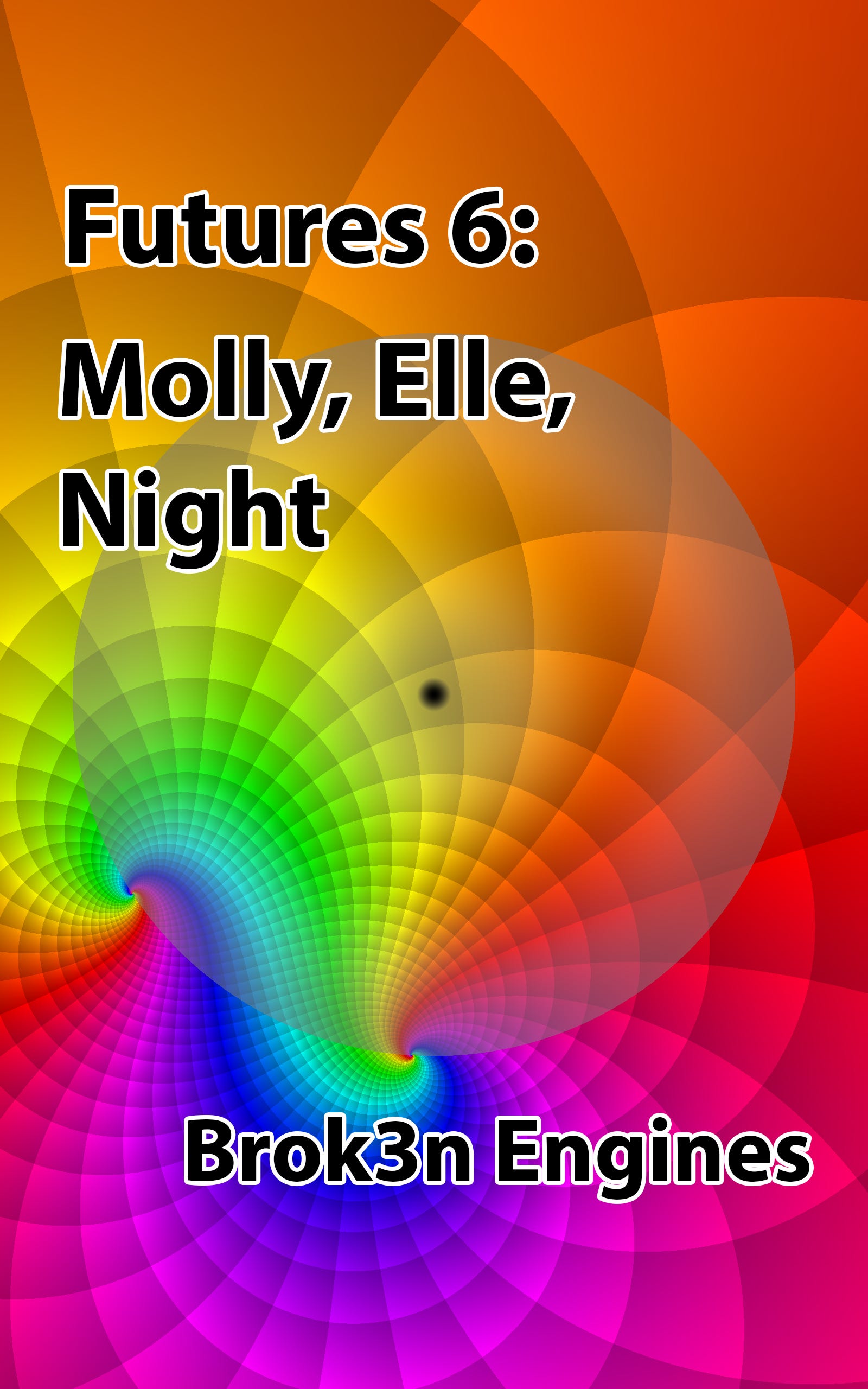
The cover image is a phase portrait of

A phase portrait is a visualization of a complex function introduced by Elias Wegert in Visual Complex Functions: An Introduction with Phase Portraits.
The portrait is rotated 30° clockwise. A semi-transparent image of Night (see Futures 4: Night) is superimposed.
The guitar string analogy was such an interesting way into the idea of time existing in more than one direction! I especially loved that Molly arrives at something almost instinctively through music that Elle then knows how to translate into physics— it made their different kinds of intelligence feel genuinely connected rather than one simply being used to explain the other. And having that same idea eventually lead to paradoxes quite literally being “pulled straight” was such a satisfying progression of the original thought.
I love the part about how knowing that something’s possible gives someone who’s trying to accomplish it an advantage, and the part about Night watching the movies that are for sale without paying for them gave me a chuckled, lol.
Looking forward to finding out how the story will continue! 💯