

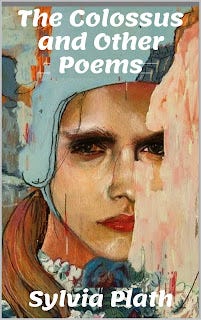
The Colossus and Other Poems
Sylvia Plath
Getting into Sylvia Plath’s head
Anne Sexton and Sylvia Plath are famous as founders of the Confessional Poetry movement of the mid-twentieth century. Sexton was admitted to a psychiatric hospital in 1955 to be treated for what we now call bipolar disorder. There one of her doctors encouraged her to write poetry to battle her melancholia. In 1974 she committed suicide. That was not her first suicide attempt, only the first successful one. Plath began writing poetry in the 1950s and wrote until her suicide in 1963. Like Sexton's, her successful suicide was preceded by several unsuccessful attempts. One certainly gets the impression that "Confessional Poet" is a terribly hazardous career choice. (Yeah, yeah, anecdotes are not data, and correlation is not causation...)
For a poetry writing class, I am required to read poems by Sexton and Plath. During her lifetime Plath published, I believe, only one book of poetry, this one, The Colossus and Other Poems. Thus I read it.
Confessional Poetry has been described as poetry of the personal or "I", and the poems of Sexton's Live or Die certainly feature of lot of first-person singular pronouns. I was thus a little surprised to discover that The Colossus and Other Poems does not. it is not until the fifth poem “The Eye-mote” that the word “I” appears, and the next occurrence after that is in the ninth poem “The Colossus”. There are a few more such poems, but Plath, at least in this book, doesn’t really emphasize the first person. Plath has more subtle ways to show us into herself. I never felt as much in Plath’s head as when reading "The Ghost's Leavetaking", which contains almost no personal pronouns.