

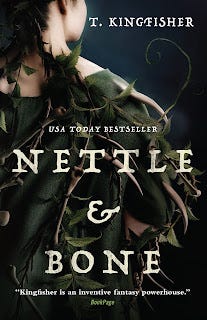
Nettle & Bone
T Kingfisher
Good-bye Earl, or Small powers do great things
I believe the first T. Kingfisher book I ever read was A Wizard’s Guide to Defensive Baking, and the second Minor Mage. (I had, however, read some of her middle grade works published as Ursula Vernon, and I was aware that Kingfisher and Vernon are the same person.) Nettle & Bone feels to me very like those two novels, but with a little of the joy let out.
Both A Wizard’s Guide to Defensive Baking (irresistible title!) and Minor Mage feature child wizards with very limited powers who are called on to do far more than anyone has a right to expect of them, and who rise to the challenge. The first quarter of Nettle & Bone is exceedingly grim. It's the all-too-familiar story of a wife suffering, as the publisher's summary says, "at the hands of a powerful and abusive" husband. She's a princess and he's a prince, but that matters only in that it accentuates her powerlessness.
The main point-of-view character, Marra, is a princess, too -- not the one married to the problematic prince, but her sister. By the time Marra figures out what's been happening to her sister Marra has spent most of her life stashed away in a convent. She is an able and practical woman, who can shovel manure, spin thread and embroider, and aid a midwife. Helping her sister looks to be an impossible job, but she undertakes to do it, regardless. On her journey to the prince's capital she gathers friends, who, like her, are folk of no great power. And, like the child wizards in A Wizard’s Guide to Defensive Baking and Minor Mage, they stretch themselves to rise to the challenge.
It's a good story, but I did not enjoy it as much as those two. Vernon/Kingfisher can be very funny. I quite enjoyed Oliver's familiar, the sarcastic Armadillo Eglamarke, in Minor Mage, and the adorable Toadling in Thornhedge. Nettle & Bone starts off very grim, as I've already described, and never fully recovers. Kingfisher tries -- there is a demon hen who is obviously intended to be humorous -- but the seriousness of the underlying problem discourages any attempt at humor or even joy.
So, in summary, it's worth reading and I enjoyed it on balance. But it is in my opinion far from Kingfisher's best work.