

Group Theory
Some time ago, when I hit 100 subscribers, I wrote a math-filled article explaining the origin of my substack logo.

I promised another such when I hit 200, and asked what y’all wanted. I got a few answers, all saying you’d be satisfied with another explanation of some other bit of mathematics.
Well, two days ago I reached 200 subscribers, and I’ve decided to write an introduction to the mathematics of symmetry. This area of mathematics is called group theory. It makes sense as a topic here, because for some of my recent stories I’ve used images based on group theory. Here are some of them.


You’ve only seen two of these yet, in


Each of these six pictures is based on a cycle graph, which is a way of visualizing the structure of a group. I am using the word “group” in a technical sense different from its usual English meaning. I will soon define it more precisely.
What is symmetry?
First, though, let’s talk about symmetry. Let’s use this picture as an example1

I think you’ll agree that it is fairly symmetrical, although the symmetry is not perfect.
Mathematicians say that a thing has symmetry if it remains unchanged after being transformed in some way. In this case, the transformation is flipping left for right. Here’s what the image looks like after doing that.

It is not exactly the same, but the cat’s face is very similar after the flipping.
It may seem odd to define a symmetry as something you can do that leaves a thing unchanged, or approximately unchanged. But this definition covers most of the usual ideas of symmetry as well as many other important things
Definition of a group
A group is a collection of all the symmetries that some thing has. Here’s the formal definition (simplified from Abstract Algebra by Dummit and Foote). A group is a set G of elements with a binary operation ★ that follows these rules:
(a★b)★c = a★(b★c) for all a, b, c ∈ G. (∈ just means “is in.”)
There exists an element e∈G, called the identity, such that for all
a∈G a★e = e★a = a.
For each a∈G there is an element a-1 called the inverse of a such that
a★a-1 = a-1★a = e.
The operation ★ combines two transformations. For instance, if m is the operation of moving everything in the universe 1 meter to the left and if r is the operation of rotating the universe 30°, then m★r is the operation of rotating the universe 30°, then moving everything 1 meter to the left. It is axiom 1 that allows you to think of ★ as performing two operations in sequence.
Axioms 2 and 3 say that the transformations represented by the group elements are reversible. e is the operation of doing nothing. It is useful to have a group element that means that in the same way as it is useful to have 0 as a number. Axiom 3 says that no matter what you do, you can always get back.
What is the smallest group? A group has to have at least one member, the identity, and axiom 2 tells us that e★e = e. The inverse of e is thus e, so axiom 3 is satisfied. And combining any number of e’s in any order gives you e, so axiom 1 is also satisfied. This is a very boring group. It has a name: the trivial group.
What does a group of two elements look like?
Let’s call the elements e and f. From the rules we know that e★e = e, e★f = f★e = f. The only question remaining is what f★f is. Rule 3 says that f must have an inverse, and the only available choice is f itself. Thus we have f—1 = f and f★f = e. You may think it’s cheating to reuse f as its own inverse, but there is nothing in the rules against it, and it’s totally kosher.
In fact, this is the symmetry of the cat face. f is the operation of flipping left and right. It is the simplest nontrivial symmetry. It has a name, Z2, the cyclic group of order 2. (It’s “Z” instead of “C” because the German word for “cycle” is “Zyklus”.)
Every group has a cycle graph. If the group has n elements, than the cycle graph is n dots joined by lines. The pattern depends on the structure of the group. The cycle graph of the trivial group is just a dot—super boring. The cycle graph of the cat face symmetry group is almost as boring.

Permutation groups
Suppose you have a deck of 52 cards, and you shuffle it. There is a sense in which the deck is unchanged when you shuffle it. In this sense the deck is unchanged by shuffling, and we can regard shuffling as a symmetry of a deck of cards.
These shuffling groups were very important in the development of group theory. The shuffling group of deck of 52 cards is named S52. S52 is a very large group. There is one element for each possible order of the 52 cards in the deck, and the number of those is 52×51×50×…2×1 = 80658175170943878571660636856403766975289505440883277824000000000000.
Suppose we have a deck of just 2 cards, let’s say the ace and two of spades.. Then there are only two possible orders: (ace, two) and (two, ace). The elements of the permutations group S2 are written {1, 2} and {2, 1}. To apply these transformations to a deck, you simply pick out the cards in the order specified. Thus {1, 2} is the group identity—whatever order of cards you start with, {1, 2} leaves them unchanged. {2, 1} swaps the cards. {2, 1} is self-inverse—if you swap the order of the two cards twice, you end up where you started.
Isomorphism
You might have noticed that S2 is a lot like the cat symmetry group Z2. It has two elements: In fact, if we were just to rename the S2 group elements, {1,2} → e, {2, 1}→f, then we would have Z2. When this is the case, when we can transform one group into another just by changing names, we say the groups are isomorphic. It is written like this: S2 ≅ Z2. Every group with two elements is isomorphic to every other group with two elements. Isomorphic groups have the same cycle graphs.
Mathematicians tend to think of isomorphic groups as being the same. Thus, when we’re not being careful, we might say that there is only one group with two elements. If p is a prime number, then there is only one group with p elements. (Strictly speaking, I should say that every group with p elements is isomorphic to every other group with p elements if p is prime.) Here are the cycle graphs for Z3, Z5, Z7, and Z11.


There are two groups with four elements: Z2 × Z2 and Z4. Here are their cycle graphs.


Symmetry of the icon
Here’s something familiar.
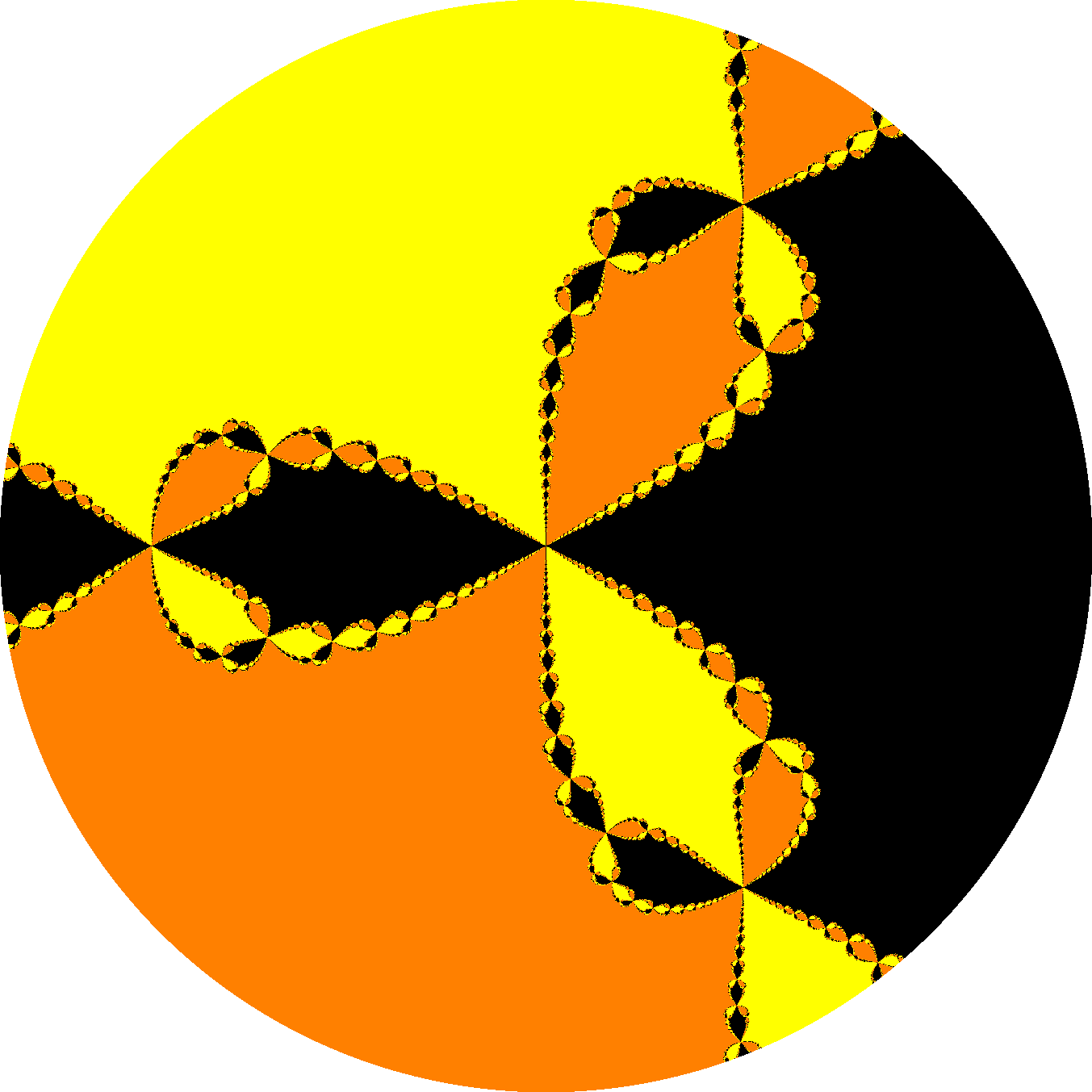
Does this have any symmetry? It does, but it is more complicated than you might expect. The first thing I think of when I look at it is to rotate by 120°. But that doesn’t work:
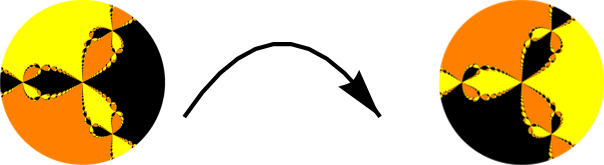
As you can see, the colors have all changed. We can get back what we started with by shuffling the colors, as follows:
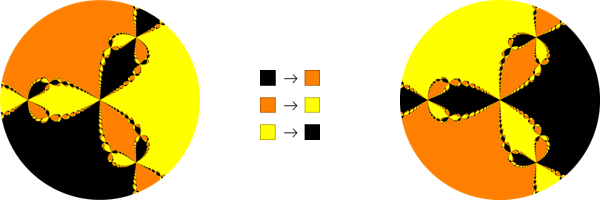
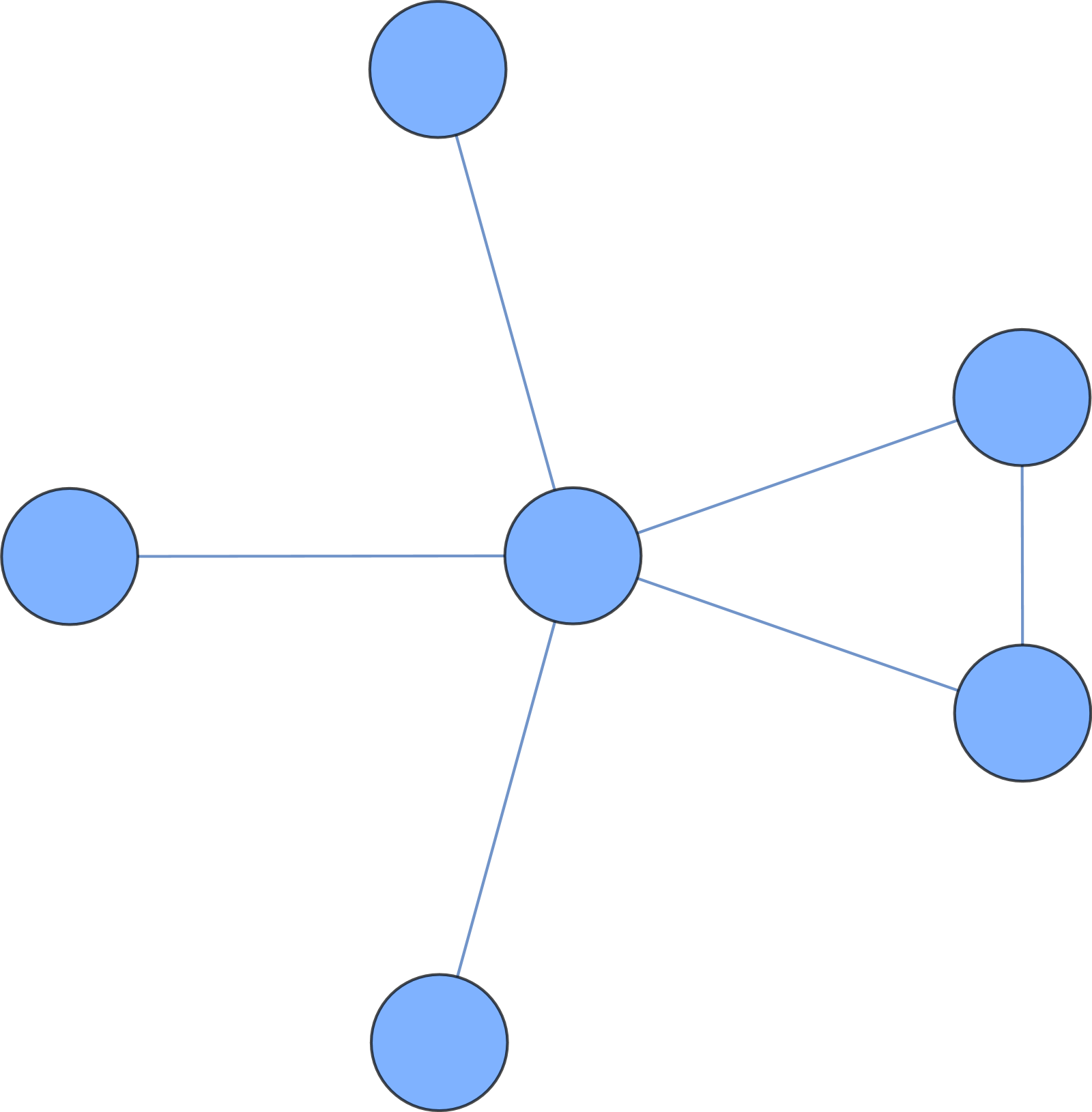
Thus, rotation by 120° followed by a color permutation is a symmetry of this image. In fact, its symmetry group has six elements, corresponding to the six rotations and reflections of the image followed by the six permutations of the three colors. The symmetry group is isomorphic to S3. Here is its cycle graph
200 subscribers!
My substack has now reached 200 subscribers for the first time. Of course these milestones are meaningless. But on some of the other creator platforms I patronize it is customary to post some sort of reward for ones subscribers on reaching a milestone.
That’s a good thing!
This is your 200-subscriber reward. What would you like me to do if and when I reach 400 subscribers?
Answer in the comments, please!
This is a free-for-noncommercial-use image placed on pixabay by Nennieinszweidrei.
I had no idea your logo had that much math hiding behind it. That's pretty neat.
Congrats on reaching 200 subscribers! 🥳
And this was a fascinating mathematical post, and my vote goes for another mathematical post for the 400 subscriber celebration too. 😎