

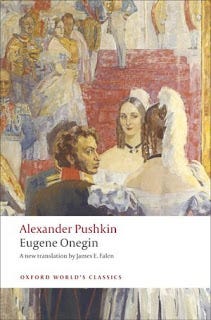
Eugene Onegin
Alexander Pushkin, James E Falen (translator)
I remember exactly where I was when I read Eugene Onegin
It rarely happens that the experience of reading a book for the first time so lights up the moment that I can picture it forever after. Eugene Onegin did that for me.
I was a grad student at Stanford University. Like many large universities, Stanford had a library for undergraduate riff-raff, and a larger library intended for, well, who knows, really? I was in the latter, looking for fiction, which I discovered deep in the basement. There, surrounded by acres of cavernous shelves, I found a cluster of big comfy chairs and sat down to read Alexander Pushkin's most famous book, Eugene Onegin. I read it in preparation for Tchaikovsky's opera. Tchaikovsky bragged that the quality of the lyrics in his opera was unimpeachable because they were taken directly from the most famous work of Russia's most famous poet. That argument struck me as kind of dumb, since everyone said that Eugene Onegin consists mostly of Pushkin's musings on anything and everything, not the story told in Tchaikovsky's opera, which in any case is in Russian, a language I don't understand.
To this day I have little love for Tchaikovsky's opera, but even in translation Pushkin's poetry blew me away. I remember reading verses in which Pushkin praises women's feet. They were so brilliant as to take my breath away. I still remember sitting in that big poofy chair, putting the book down, and saying to myself, "Wow!" (Yeah, well, I never claimed to be a poet myself.) Now, I suspect most of you reading this review already know that those verses are among Pushkin's most famous. I was only to learn that later. I had the pleasure of discovering them for myself.
I want to make it clear, however, that there is more to Eugene Onegin than feet. No one knows what another will love, but if you are at all susceptible to classic poetry, you owe it to yourself to have a look at Eugene Onegin.
Reading Pushkin in a university library sounds amazing—at least from the perspective of someone who didn't go to college like me.