

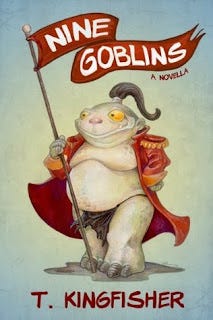
Nine Goblins
T. Kingfisher
...it might look like this.
Nessilka is a goblin soldier. She's a sergeant and leads a small troop of other goblin soldiers in battle against human soldiers. Goblins used to live everywhere, but the humans-- there are more of them every year! -- have been moving in on the goblin lands, until there is no place where goblins can live in peace. That, at least, is the goblins' story -- humans would tell a different story. But have you met humans? The goblin story is all too plausible.
Sings-to-Trees is an elf. He lives alone in a forest, and he takes care of all the forest creatures: troll, unicorn, or raccoon -- if you're hurt, Sings-to-Trees will heal you and care for you. He lives alone because this is messy work, and other elves regard him as déclassé.
In battle Nessilka and eight of her troop are accidentally transported out of the battle by a wizard attempting to flee. They all end up near the wizard's village and also Sings-to-Trees' forest, many miles from their home. Things happen, which I won't tell you.
OK, let's be clear. Ursula Vernon and T. Kingfisher are the same person. As Vernon she publishes middle grade books like Castle Hangnail, which are full of Low Humor, and very funny. She also writes books for adults, in which she displays extraordinary range, from Horror to Low Humor. (Actually, the Low Humor is pretty much a constant.) A middle-grade author has to be careful about brand management -- her ten-year-old readers need to be shielded from the frequent grue of her adult books. For this purpose she invented "the vaguely absurd pen-name" T. Kingfisher, which she identifies as "the name she uses when writing things for grown-ups".
Nine Goblins begins like a typical Urusla Vernon novel. But as you read on, it moves gradually, then abruptly, into Kingfisher territory. Near the end it becomes quite dark, but still with plenty of Low Humor.
This was a lot of fun.