

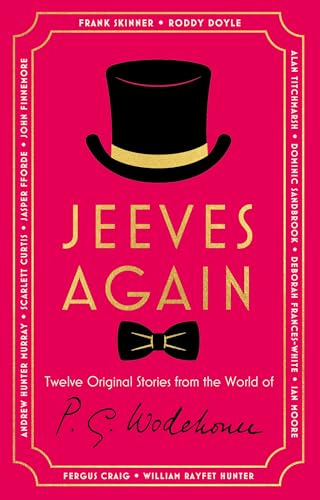
Jeeves Again: Twelve New Stories
Frank Skinner, Roddy Doyle, Alan Titchmarsh, Dominic Sandbrook, Deborah Frances-White, Andrew Hunter Murray, Scarlett Curtis, Jasper Fforde, John Finnemore, Ian Moore, William Rayfet Hunter, Fergus Craig
Jeeves at 110
I follow Jasper Fforde on substack, so when he posted a note about contributing to a new collection of Jeeves and Wooster stories I was intrigued. Never know what you’re going to get in a package like this, but I figured Fforde‘s story alone would probably be worth the price of the book and pre-ordered it.
It’s great! Every story is good. There was only one story that I felt didn’t quite hold up, but even in that case (which I will not name) it was more that the author clearly decided to take a risk, and it didn’t quite pay off. There was a lot of that sort risk-taking, and in all but that one case the authors beat the odds, in my opinion.
Jeeves first appeared in print in 1915, so unfortunately for those who favor round-number anniversaries, they missed the hundredth. But a lot of water has flowed under the bridge. A few of the authors did what I would have considered the obvious thing: they had Bertie narrate a new story set in the early twentieth century in which he gets into trouble and Jeeves gets him out. This is hard, because it leaves the intrepid author trying to do what P.G. Wodehouse himself did, and Wodehouse is a damn tough act to follow. The last two stories, by Fforde and Ian Moore were of that nature. Both of them, in my opinion, give Plum a run for his money.
Other writers set their stories in later times. For instance, at least two were set in or around World War II, and one or two in the twenty-first century. They use various tricks to justify the time displacement.
Another trick the writers use is to focus on some character other than Bertie and Jeeves. For instance, Scarlett Curtis‘s contribution “On Becoming Aunt Agatha” is told from the point of view of Aunt Agatha. Aunt Agatha always puzzled me a bit -- in the original stories, she’s a paper tiger -- aside from saying horrible things to and about Bertie, she never really inconveniences him all that much. His “good and deserving” Aunt Dahlia is a far more productive trouble-maker. I suspect Curtis noticed the same thing.
Dominic Sandbrook‘s story “The Age of Spode,” focuses on Roderick Spode, Earl of Sidcup. It is written as an exam administered to history students at Market Snodsbury University. It consists mostly of purported news stories about Spode, whom we are given to understand eventually became a Tory elder statesman. Bertie and Jeeves barely appear. This one was a lot of fun.
That brings up a warning: These stories make real demands on your memory. The authors assume that you’ve read most or all of Bertie’s oeuvre and remember all the inhabitants and their relationships. For instance, several authors require that you remember how Spode, Madeline Bassett, and Bertie are entangled. For me that wasn’t a problem.
In the copyright section, these words appear, “This work is published with the permission of the Estate of P. G. Wodehouse.” I don’t know how routinely that permission is given. But I am very glad that it was in this case, and if Wodehouse is looking down or up at us from somewhere, I imagine he, too, approves.