

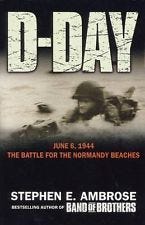
D-Day, June 6, 1944: The Battle for the Normandy Beaches
Stephen E. Ambrose
I believe I read Stephen E. Ambrose's D-Day, June 6, 1944: The Battle for the Normandy Beaches after watching the movie Saving Private Ryan, one of the many movies in which worlds and nations are put to enormous trouble to get Matt Damon out of trouble. (Honestly, think about it: Saving Private Ryan, Interstellar, The Martian. Wouldn't it be cheaper to just get the guy a Navi?) Saving Private Ryan (1998) was based in part on this book (published in 1994). I note that there is a more recent edition D-Day: June 6, 1944: The Climactic Battle of World War II, published in 2013. I have not read that.
I was recently reminded of D-Day because I'm working my way through William Manchester and Paul Reid's The Last Lion: Winston Spencer Churchill: Defender of the Realm, 1940-1965. This, the last volume of their huge biography of Winston Churchill The Last Lion, is largely a history of the Second World War from the English point of view. Last night I reached 80% in that HUGE last volume and arrived at D-Day.
I note that most of the less positive reviews of D-Day make the same complaint: that it is focused on US soldiers, and particularly on the landing at Omaha Beach, one of the two where American troops came ashore. Fair enough -- it is that. (And remember, I haven't read the 2013 edition, so I don't know if Ambrose did anything about this.) Honestly, this strikes me more as a complaint about the title than about the book itself. If Ambrose had called it D-Day, June 6, 1944: The Battle on Omaha Beach, there would be no reasonable basis for complaint. It was not unreasonable to write a history focused on Omaha Beach. Even Manchester and Reid (who are by no means inclined to exaggerate the US role -- quite the opposite) write
The news from the British and Canadian beaches was good, as it was from the westernmost American beach, Utah, where fewer than 200 men of 21,000 were killed going ashore. Tanks had raced across the causeways and established contact with the airborne units. But on Omaha it was a bloody and close-fought affair.
It was on Omaha that Rommel and Rundstedt concentrated their defense, and the US troops there took the brunt.
Thus, if you're thinking of reading D-Day, go into with eyes open: it's mostly about the US soldiers who went ashore at Omaha Beach.
The main lesson I remember now, a quarter century after I first read the book, was that Ambrose attributes US success mainly to their flexible command architecture. The invasion did not go according to plan: the preparatory bombardment that was supposed to obliterate the defense failed almost completely. Because American soldiers are encouraged to take initiative, they had the freedom to innovate workarounds. Hitler, by contrast, had personally taken command of his forces. He was not on the spot and could not direct forces to where they were needed. It is not that US soldiers were smarter or braver than Germans -- four years of war had shown that the German soldiers were pretty damn good, and Rommel, of course, had been one of their best.
Ambrose's D-Day is an excellent history of the US landing on Omaha Beach. If you understand that's what you're buying, you'll get your money's worth.