

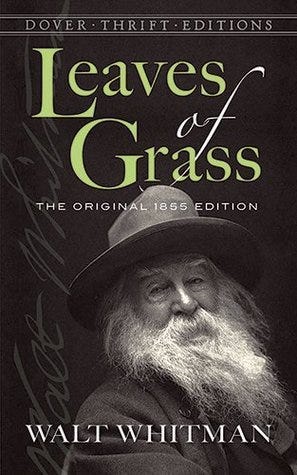
Leaves of Grass: The Original 1855 Edition
Walt Whitman
Everything is beautiful in its own way
It is often observed that great artists sometimes make great art by breaking all the rules. Unfortunately, many not-great artists believe that the converse is also true, that if you break all the rules, you are necessarily a great artist.
This, alas is not true. The number of mediocre and poor artists who break all the rules greatly exceeds the number of great artists who break all the rules.
So, where does Walt Whitman fit in? He definitely breaks all the rules of poetry, or all such rules as there were when he wrote. He is not a poor or mediocre poet. Indeed, general critical opinion (with which I agree) is that he touches greatness.
Leaves of Grass is worth a read, but it will never be one of my favorite volumes of poetry. I tend to admire more those artists who manage to produce great work while coloring within the lines. Also, a frustrating thing about Whitman is that he has one thing to say -- a message of extreme openness and beauty. The main thrust of his poems, if you read them for their meaning, is roughly the same as the unbearably dreary, drippy Ray Stevens song Everything is Beautiful, with which I was regularly assaulted growing up. (To be fair, Whitman is free of the religious cant of that music-like performance.)
So, you should not read Whitman's poetry for its meaning, or not just for its meaning. Whitman is far, far more eloquent than Stevens, and far less preachy.
Still it is hard to read Leaves of Grass without wishing Whitman could be a little more organized, a little less repetitive, and a little more concise, or I found it so.. Whitman knows he is not these things, but while confession may be good for the soul, it is not necessarily good for ones poetry.
Leaves of Grass begins with an 18-page stream-of-consciousness prose introduction, which is mainly about Whitman's vision of America. (As I read it I thought that Whitman would barely recognize Donald Trump's America. It was not a happy thought.) It is followed by a 48-page stream-of-consciousness free verse poem entitled "Leaves of Grass." This is followed by six shorter poems also entitled "Leaves of Grass." These are followed by a seventh untitled poem. None of these seven poems is marred by any attempt at thematic unity, although the last two are divided into parts by horizontal rules, and there is some thematic unity to each such part.
Whitman deserves attention, and Leaves of Grass is mercifully short.