

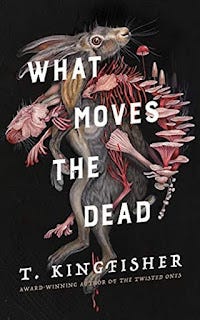
What Moves the Dead
T. Kingfisher
Let’s see if I can get these pronouns right...
T. Kingfisher's What Moves the Dead is a retelling of Poe's The Fall of the House of Usher. The plot is sadly predictable, and I will say no more about it.
What I enjoyed most was the setting. The story happens in 1890. The main characters are Lieutenant Alex Easton and Roderick and Madeline Usher, who used to be Alex's childhood friends. Alex, our first-person narrator, hails from the tiny European nation-state of Gallacia, which Alex describes thus
If you have never met a Gallacian, the first thing you must know is that Gallacia is home to a stubborn, proud, fierce people who are also absolutely piss-poor warriors. My ancestors roamed Europe, picking fights and having the tar beaten out of them by virtually every other people they ran across. They finally settled in Gallacia, which is near Moldavia and even smaller. Presumably they settled there because nobody else wanted it. The Ottoman Empire didn’t even bother to make us a vassal state, if that tells you anything. It’s cold and poor and if you don’t die from falling in a hole or starving to death, a wolf eats you. The one thing going for it is that we aren’t invaded often, or at least we weren’t, until the previous war.
In the course of all that wandering around losing fights, we developed our own language, Gallacian. I am told it is worse than Finnish, which is impressive. Every time we lost a fight, we made off with a few more loan words from our enemies. The upshot of all of this is that the Gallacian language is intensely idiosyncratic. (We have seven sets of pronouns, for example, one of which is for inanimate objects and one of which is used only for God. It’s probably a miracle that we don’t have one just for mushrooms.)
The story takes place in the ancestral home of the Ushers in another small miserable European nation, Ruravia. Roderick served under Alex in the military --how exactly that worked, Roderick being Ruravian and Alex Gallacian, was never explained that I noticed.
Gallacian has special pronouns for soldiers, "ka" and "kan". It is a dire insult to a soldier to fail to address kan with ka/kan. They apparently work like she/her in English: ka for the subject of a verb, kan for everything else, including possessive. ka/kan is used for both men and women. Historically all soldiers were men, but then a woman joined and since all the laws referred to soldiers as ka/kan nothing in the letter of the law forbade ka to become a soldier. Thus it came to pass that about a third of Gallacian soldiers are women. Gallacian soldiers are called "sworn", thus the name of the series Sworn Soldier. If Alex ever explains the proper plural for soldiers I missed that, so I will have to use they/them and hope any Gallacian soldiers I may happen to run into don't take offense.
This all reminded me of Neal Stephenson's Qwghlm, a fictional archipelago near Britain, that was in past centuries a tiny miserable linguistically isolated nation like Gallacia but now seems to belong to the United Kingdom in some form. Of course there are real-world examples of tiny European nations, e.g. Lichtenstein and Monaco. In the 21st century these are not as linguistically isolated as Gallacia and Qwghlm, but Lichtenstein does have its own dialect of German and Monaco has Monégasque (a dialect of Ligurian, itself an Italian dialect), although the official language is French.
I intend to continue to read the series, mainly because I have faith in Kingfisher. Gallacia is fun (though I like Qwghlm better), and I'm pretty sure Kingfisher can do better with the plot.