

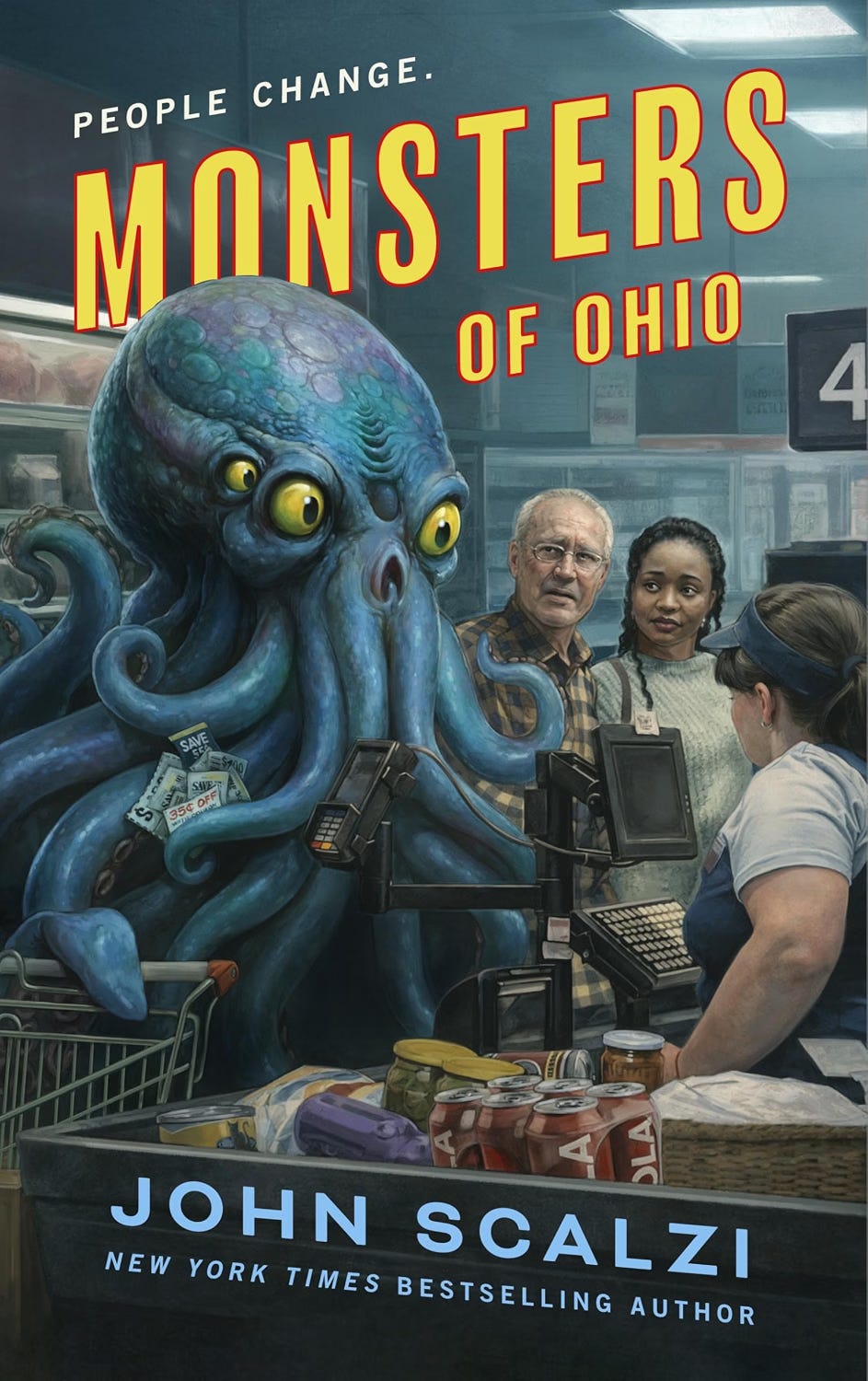
Monsters of Ohio
John Scalzi
I didn’t believe it
There’s a question that has long puzzled me: what makes a story believable? Some time ago I read the extraordinary story of World War II spy Virginia Hall. (The book is A Woman of No Importance: The Untold Story of the American Spy Who Helped Win World War II, by Sonia Purnell. Here is my review.) As I read it, I thought, “This could not be a novel, because no one would believe it.” Of course, I am not the first to observe that truth can be stranger than fiction. Writers of fiction frequently complain that they are not allowed to make their stories as implausible as reality.
But what has long puzzled me is how this works in Fantasy and Science Fiction. A naive person would think that there are no plausibility or believability constraints in F&SF -- you can imagine magic or technology to make anything happen that you want. In fact, this is the opposite of the truth. Believability is even more a constraint in speculative than in mainstream fiction, for the very reason that it is inherently unbelievable. I think an F&SF author establishes a contract with the reader that specifies what is allowed to happen and what is not. It is not an explicit, stated contract, but it exists somehow. I don’t know how they do it. I am not COMPLETELY in the dark, of course. Some of the mechanisms are obvious and known to all. (Much of it comes under the heading of world-building.) But, I insist, the contract is mostly unstated, usually unknown to the reader and perhaps as well to the author.
So, when I complain that Monsters of Ohio, a story in which people and animals explode and turn into tentacled monsters (I’m not counting that as a spoiler, because look at the cover!), seemed implausible to me, I know how dumb the complaint sounds.
I kind of wish I could get John Scalzi‘s take on this. I am a fan and usually like his books. I’m pretty sure that he knows exactly what he did. Indeed, I expect he would understand much better than I do myself what bothered me about Monsters of Ohio.
But there it is -- I don’t know. I had fun with the story, but I didn’t believe it. That diluted my enjoyment.