

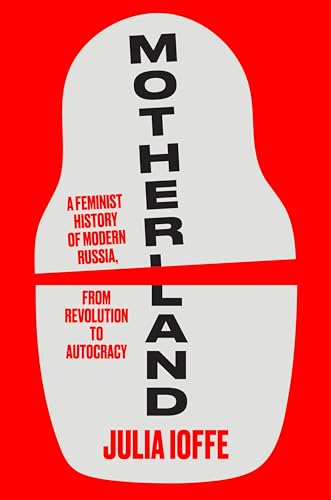
Motherland: A Feminist History of Modern Russia, from Revolution to Autocracy
Julia Ioffe
The tragedy that is Russia
It was around 2012 that I discovered The New Republic through the miracle of RSS. TNR at that time was an extraordinary bouquet of talented journalists. Julia Ioffe was one of them. She was always clear, a pleasure to read, and insightful, especially concerning Russia. TNR imploded in 2014 and those writers scattered to the four winds. I mostly lost track of Ioffe at that point, although she continued to pop up in occasional bits of drive-by free-lance journalism, such as this article in GQ: Now We All Know What Putin Has on Trump. It was so clear and obvious an insight as to make me wonder why I had never seen it for myself. (In my defense, no one other than Ioffe did, either.) She eventually found a home at Puck, but the volume of her journalistic output is low.
I know the reason, now, or part of it: she’s been writing Motherland: A Feminist History of Modern Russia, from Revolution to Autocracy, an extraordinary history and memoire of Russia in the 20th and early 21st centuries.
I have a bone to pick with the subtitle. Ioffe makes clear that because of the divergent history of women in Russia and America, the word “feminist” has entirely different meanings in the two nations. Motherland is not a feminist history, in the sense that the word is usually used in the West. It would have been clearer and more accurate to call it “A history of Russia seen through the eyes of its women.”
Ioffe is a Russian-born Jew, Her family moved to the USA in 1990, when she was seven years old. She moved back to Moscow from 2009-2012, where she worked as a reporter, covering (among other things) Pussy Riot and the Navalnys.
Motherland begins with family trees showing four generations of Ioffe‘s ancestors, Russian Jews all1. The narrative (carefully sourced and documented) tells the story of Russia from the early days of the Bolshevik revolution through Putin’s Russia. The story is told almost entirely by telling the stories of women: Ioffe‘s ancestors, and other women who led the nation.
It’s a bleak tale. Russia has treated its women badly, and it’s treated its Jews badly, and historically it’s been an extraordinarily awful place to be a Jewish woman. Russia was always ready to allow its women those parts of feminism that involved suffering for the Fatherland and its men. Russian women fought in the Great Patriotic War (what we call World War II) and worked full-time jobs from the early days and still do any job that doesn’t put them in charge of things. But don’t run away with the idea that Russian men live good lives. Ioffe makes it clear that the suffering inflicted on womankind redounds in different and sometimes even worse ways on its men.
Motherland reads like a novel. It’s a dramatic and exciting story, if an extraordinarily bleak one. Ioffe writes so well. Here is one of the many passages I highlighted.
Till her dying day, my grandmother Emma believed that her cousins were buried alive, though she had no way of knowing whether that is what actually happened. I sometimes asked her why it mattered how they died, but to Emma, who vividly remembered her cousins—Polina, who at the time of her death was seventeen, Lyuba, fifteen, and Zhenya, five—it mattered a lot.
It’s good. If you have any interest in Russia, read it!
I am always bemused by authors who can do this. Our greatest president, Abraham Lincoln, wrote
I don’t know who my grandfather was, I am much more concerned to know what his grandson will be.
That first sentence is almost literally true for me. Both my grandfathers died when my parents were children, and I know nothing of them. I know only slightly more about my grandmothers.