

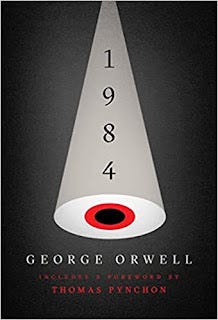
1984
George Orwell
My first dystopian novel
I first read 1984 as a high school student. I remember that when I read it the year 1984 was still somewhat blurrily distant. George Orwell obviously chose the year 1984 in order to place his novel in a future distant enough not to be clearly foreseeable, although he is careful to cover himself by having Winston admit that he doesn't really know what the year is. I was in high school when I read it, probably 1971, so I would have been fifteen years old. From that perspective 1984 still seemed a fairly distant future.
There were two famous dystopian novels that our high school teachers often mentioned: 1984 and Brave New World. Having always been bookish, I read both, first 1984, then Brave New World. And somewhere along in there I also read Animal Farm.
As usual for a book I read so long ago, I have only vague memories of the plot of 1984. But I do well remember the strong impression it left on me. It was one of the bleakest, most despairing books I had ever read. Orwell leaves his readers very little hope -- either for his characters, or for us. He makes the political world of 1984 and a total loss of hope appear inevitable. From my perspective as a fifteen-year-old in 1971, it seemed inevitable that the Soviet Union would come to rule the world. For me it was a simple syllogism -- the USSR would do whatever it took to rule, while we in the West allowed considerations such as freedom and charity to influence us. (You are free, of course, to disbelieve that, but it was what fifteen-year-old me believed.) They would beat us because they fought with everything they had, while we fought with one hand tied behind our back. I saw little hope.
Obviously my despair was not justified. From my perspective today it seems the world changed little between 1971 and 1984 -- the end of the Vietnam War was the most obvious change I saw. The world changed much more in the thirteen years that followed 1984. By 1997 the information and bio- technology-saturated world we now inhabit was coming dimly into view. The Soviet Union, far from ruling the world, had collapsed.
1984 is still an important book, because I still think we could go there. But for me it has taken on the added significance of demonstrating that the worst is not inevitable (or at least can be put off). And in addition it taught me the always valuable lesson that I stink at geopolitical prognostication.