

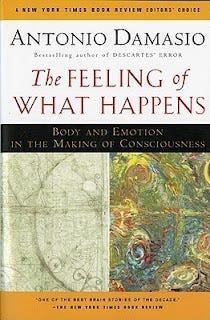
The Feeling of What Happens: Body and Emotion in the Making of Consciousness
Antonio Damasio
Neither a clear writer nor a clear thinker
Having heard that António R. Damásio's was a name to conjure by on the question of neuroscience of consciousness, I read The Feeling of What Happens: Body and Emotion in the Making of Consciousness in 2008. I thought it was very bad. I posted a review on Amazon. That review has now vanished, and Amazon tells me "We apologize but Amazon is not accepting reviews on this product from this account," meaning me. I am thus left to reconstruct the gist of my review from memory.
In fact, the gist is in the title above. Damásio doesn't write clearly. As is often the case, failure to write clearly is the outward symptom of a deeper pathology: failure to think clearly. Damásio loves to sound poetic, usually at the expense of conveying a clear meaning. To write my previous review, I opened the book and picked out a sentence at random. Although I didn't look for an incomprehensible sentence, I landed on one. I wrote at the time, "Even though I have finished the book, I have only the vaguest notion of what Damásio is trying to say here." (I am, I should mention, a card-carrying neuroscientist, so it wasn't technical jargon that defeated me.)
As for failure to think clearly, Damásio repeatedly contradicts himself. One egregious example essentially destroys the entire premise of the book. Late in the book, he says something like (wish I had the exact quote) "It is impossible to infer mental states from observations of behavior." Yet this is the ENTIRE book. He spends most of the book inferring things about his patients' mental states from what they say and do.
Skip it.
The Feeling of What Happens on Amazon
I just downloaded all my old data from amazon. It includes even the old, now banned review of this book:
I have just finished reading this book with a great sense of relief. I wish I could agree with all the complimentary things that other reviewers have written about it, but I find I can't. I am convinced that Damasio is an insightful neurologist, and his personal observations and extensive knowledge of patients with neurological conditions is valuable. However, he is neither a clear thinker nor a clear writer. He goes in for the poetic and artistic, and while his language may sound great, more than half the time I didn't know what the Hell he was actually trying to say. Here's an example: I literally opened the book at random and chose the first sentence I came on: "Knowing springs to life in the story, it inheres in the newly constructed neural pattern that constitutes the nonverbal account." If you think the meaning of that sentence would be clearer after you had read all the book that preceded it, you're wrong. I have read the entire book, and I still have only a vague idea what Damasio is trying to say here. When he is not being poetic, Damasio is technical. A card-carrying neuroscientist myself, I nevertheless struggled to understand some of Damasio's jargon.
More disturbing than the lack of clear expression was the lack of clear thinking. Damasio is often illogical and often contradicts himself. For instance, late in the book, he states, "The idea that the nature of subjective experience can be grasped effectively by the study of their behavioral correlates is wrong." In most of the chapters that precede this statement, however, he does exactly that. He describes what he supposes to be the subjective experience of neurological patients based on his observations of their behavior. He confidently states over and over again that this patient is conscious and that one is not, without ever clearly saying how he knows -- without defining the criteria on which he bases that judgment.
Perhaps I was spoiled, because just before reading this book I read Daniel Dennett's _Consciousness Explained_. The ideas in that book were intrinsically much more difficult to grasp, but they were stimulating, insightful, and expressed in a way that was both engaging and clear. I was sorry to reach the end of it. Reading Damasio, in contrast, was a punishment I forced myself to endure, and whose cessation is a relief.