

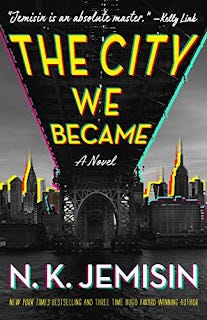
The City We Became
NK Jemisin
I have a problem that will make it difficult for me to appreciate The City We Became. I have never been able to see a city as a thing. I lived in Dallas, Texas, for 21 years. I remember the schools I studied at, Brookhaven Community College and Southern Methodist University. I remember the school I taught at, UT Southwestern Medical Center. I remember the hospital area of Dallas, Harry Hines Boulevard and the businesses and institutions along it. I remember the functionally nonexistent public transport. I remember the highways -- I-635 circling the city, east-west roads I-30 and 114 and north-south roads 75 and the Tollway crossing to form the crosshair whose bullseye was Downtown Dallas, and I-35 striking out diagonally toward Denton and Houston. I remember the velocitous terror of driving through the Mixmaster at 60 mph, hoping not to be flung off in some random direction. I remember timing my trip home in the evening so as to see the reflection of the sunset from the prismatic skyscrapers of Downtown. I remember the Arts District and the Symphony screaming, "See? We are TOO sophisticated and artistic!" I remember the gay bars of the Oak Lawn district (never been inside one, but even from the outside they were something!), and the complaints from folks who spent an evening partying in Deep Ellum.
What makes no sense to me, however, is to throw all these things into a bag together and call it "Dallas". Partly, of course, that is because I sense how much is missing -- how much of Dallas I (or any one person) did not appreciate because of who I am and what I do. But it's more that those are separate things -- they don't combine into an identity. If you asked me to compare New York to Dallas, I would scarcely know how to start. It's like being asked to compare the Atlantic Ocean to Shakespeare's Hamlet -- it just doesn't make any sense to me.
**N.K. Jemisin has entered the chat **
NKJ: Hey there, L. I'm not a *bleep*ing idiot. I'm 'way ahead of you. Your objection is basically the whole premise of the book. As the publisher's blurb says, "Every great city has a soul... She's got six." Besides -- Dallas -- Pfft. Doesn't have a soul and never will.
L: Yeah, OK. I admit you did in some degree anticipate my point, even though you dumbed it down. I don't buy that the Bronx, for instance, is a single thing.
NKJ: I have a story to tell. There's not space for every *bleep*ing last real-world detail.
L: Fair enough.
(In case it is not clear to anyone, this dialog is 100% fictional.)
A book like this inevitably lives or dies by its portrayal of The City. I am ill-equipped to judge Jemisin's New York, for reasons already described. I wish now I could ask my Aunt Althea's opinion. Aunt Althea was a nurse in Europe in World War II. She came home to the USA, where she worked at Sloan-Kettering Cancer Center on Manhattan for many years. Besides saving lives, she read and read and read. If she were still available for consultation I would ask her, "Have you read The City We Became? [A mere formality -- of course she'd have read it.] What did you think?" In a way, though, she pre-answered the question. She gave us Winter's Tale by Mark Helprin, another novel that personifies the soul of New York.
Our world is desperately cruel and beautiful. Consequently, so too are its cities. It is inevitable in novels such as City We Became and Winter's Tale that the cruelty of The City becomes evident. Helprin's New York differs from Jemisin in making beauty and joy more prominent. Helprin's portrayal is also more explicitly historical, and also more white. City We Became shows a side of New York that is difficult to discern in Winter's Tale.
I think Aunt Althea would have liked it.