

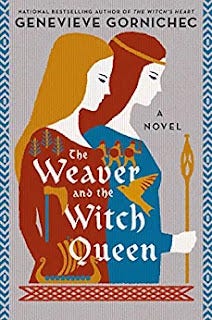
The Weaver and the Witch Queen
Genevieve Gornichec
This is how Genevieve Gornichec's author biography begins
Genevieve Gornichec earned her degree in history from the Ohio State University, but she got as close to majoring in Vikings as she possibly could, and her study of Norse myths and Icelandic sagas became her writing inspiration.
The Weaver and the Witch Queen is historical fiction set around 930 CE in what is now Norway. We can be precise about the date because many of the characters are historical figures. If I name even one of them it will spoil the story, but here, in a spoiler tag, are two key names: Gunnhild, Mother of Kings, and Eirik Blood-axe.
And it was a different world! Men achieved wealth and power by raiding: a troop or warriors piled into a ship, sailed to some poorly-defended town or farm, and pillaged it of all its valuables and also stole away some of its inhabitants to be sold as slaves. This kind of activity has several names in modern English: "piracy" is one of them. A few women participated in these raids, but most stayed at home. Besides fighting off raiders, the women did things like weaving, cooking, healing, and raising children.
It is just a matter of course that a man kills other men (and also, quite likely, women and children). It is not seen as a crime, as long as he follows the rules. One rule, for instance, is that you are not supposed to kill your brothers. That is kinslaying, and it is a heinous crime. Don't mistake the word "crime" to imply anything to do with a criminal justice system that hunts down and punishes criminals. "Crime" just means an action that is universally condemned. If you do such a thing, and if your enemies seek to kill you in retribution, no one will defend you.
What most struck me in the first half of Weaver and Witch was the utter lack of sentimentality. Marriage is entirely transactional. A man can have multiple wives, and a powerful man is expected to. Marriage exists to build wealth, consolidate alliances, and (of course) get children. They don't scorn love -- it's great if it happens, but it is not necessary or really even expected. There is a marriage proposal in the story. The man making the proposal knows and acknowledges that the woman he proposes to despises him, but he argues that by marrying they can both achieve their different goals most effectively.
So, be prepared to do the Cultural Relativity Shuffle. I think it will be difficult to enjoy Weaver and Witch unless you can put yourself in the minds of the characters to the extent of understanding that while their values are quite unacceptable to you, they nevertheless have strong notions of right and wrong.
Now, I called Weaver and Witch historical fiction. It is also fantasy, but barely so. It is fantasy because there is magic -- witchcraft -- and Gornichec admits in her Author's Note that she made up the magic system, "The magic system in this novel, while inspired by historical sources, is largely from my own imagination." I say it is "barely" fantasy because witchcraft was real to the tenth-century Norse people. They believed in it, and to some extent their witches did real, non-magical things, such as herbal healing. Gornichec invented the magic system, but she didn't invent Norse witchcraft.
In a careful Author's Note, Gornichec argues that, because the historical sources are so poor (most written centuries after the events by Christian descendants who were culturally quite different), even the best histories of the Viking Age are "sometimes akin to a sort of speculative fiction of the past." Nevertheless, Weaver and Witch felt authentic to me. I harbor some doubts as to whether people who thought this way really existed, but I am pretty much convinced that it is the way they wanted to see themselves.
So, after all that background -- the story! It's about three girls/women, sisters Oddny and Signy and their best friend Gunnhild, who swear an oath to stand by each other. Signy is out of the picture for most of the book -- Oddny and Gunnhild are the titular characters. As you might expect from what I've already said, it's a story of violence and treachery and magic. Also too, love. The love stories are rather different from the (IMO) vapid romances that flood the best-seller lists, and all the better for it!
Weaver and Witch is not for everyone. I would predict that many readers will hate everyone in it, for entirely understandable reasons! But it's an opportunity to expand your mind.