

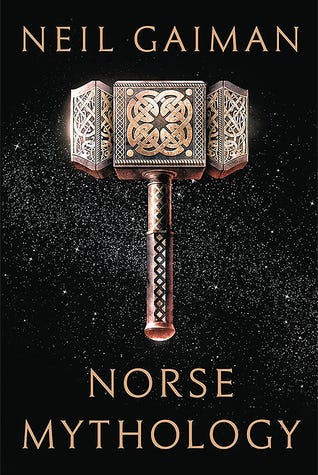
Norse Mythology
Neil Gaiman
A version of Norse mythology
The problem with Norse mythology is that most of it was never written down. This contrasts with, for instance, Greek mythology. Some of the Greeks (the ones in Athens, especially) were very much into writing stuff down, and they were backed up by the Romans. It's not that the Northmen didn't care about scholarship. They had their skalds, who were, by all accounts, erudite. But it was an oral tradition. One of the problems with oral tradition is that, if you stop paying attention for a generation, stuff gets lost -- forever. Paper and parchment, if well treated, can survive lapses of attention.
Someone did eventually write parts of it down, of course. But the development of literary scholarship in the Northlands happened when Christian priests came in to convert them. These priests, although they included some open-minded scholars interested in preserving the old stories, were institutionally hostile to the old religion. Most of what we have of Norse mythology comes to us from two works, The Poetic Edda: Stories of the Norse Gods and Heroes and The Prose Edda: Norse Mythology. I have read neither, although I intend to correct that soon.
Neil Gaiman writes in his Introduction to Norse Mythology, "It is, perhaps, as if the only tales of the gods and demigods of Greece and Rome that had survived were of the deeds of Theseus and Hercules."
He makes no attempt to be complete. Gaiman's Norse Mythology is a sort of retelling. It is based on his reading of translations of the original sources, not on any of the compilations by other authors. Gaiman is of course an excellent story-teller, which was why I chose to read his version. (I'll also mention that I bought and first read this book in 2017. I knew nothing of his now well-documented misdeeds.)
It is, of course, well-done. They are powerful stories and Gaiman tells his version of them well.