

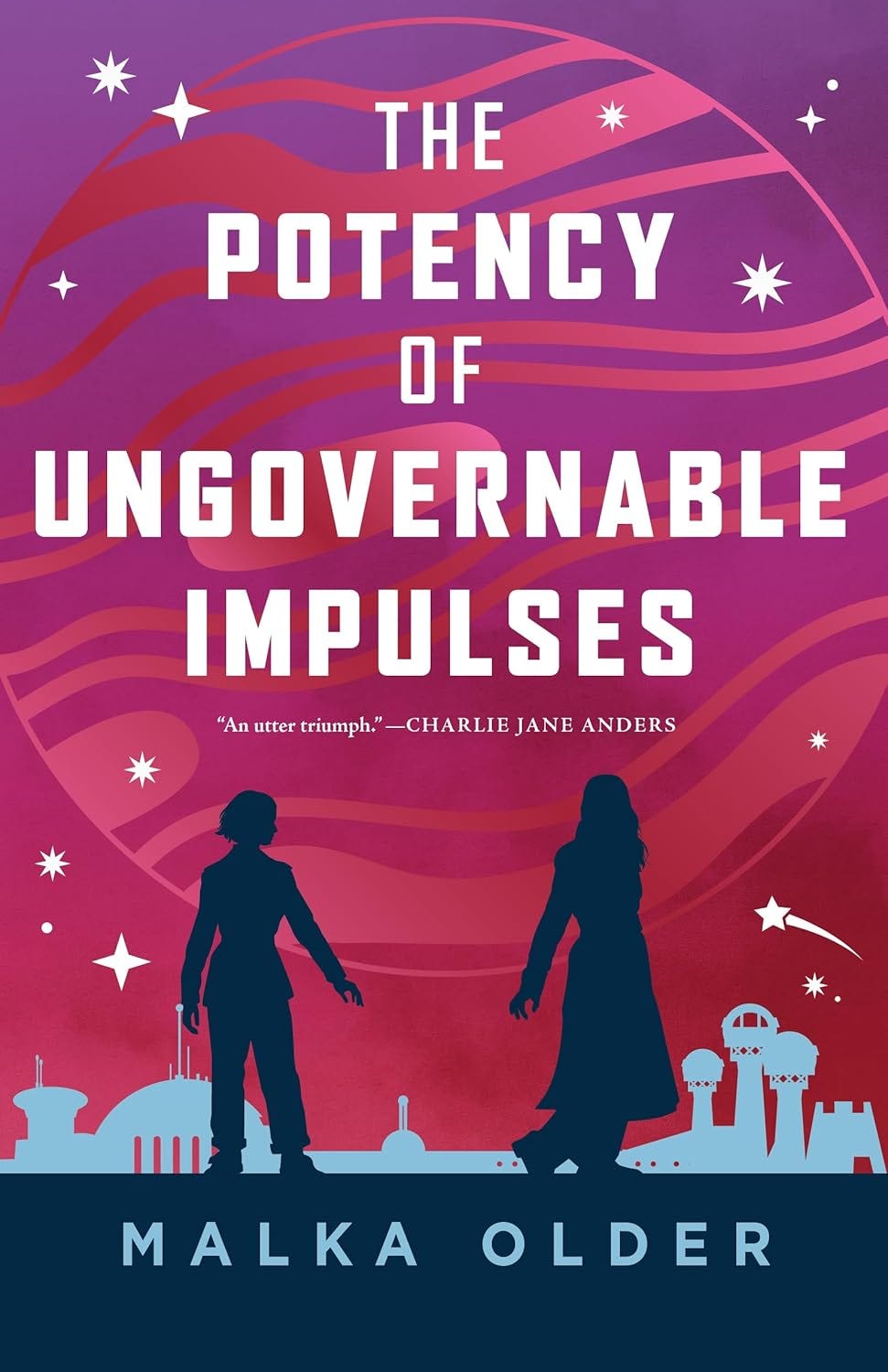
The Potency of Ungovernable Impulses
Malka Ann Older
Pleiti vs the Comemierdas
Novel 3 of Malka Ann Older's Mossa and Pleiti mystery series continues the established scheme of choosing complex abstract noun phrases as titles, in this case The Potency of Ungovernable Impulses.
The Mossa and Pleiti mysteries take place on a future Jupiter (referred to as "Giant"), after humanity has precipitated ecological disasters that left Earth and Mars uninhabitable. The world-building is unusual. In the first two novels Older gave us just barely enough technical information to explain how she imagines humans living on a gas giant plant. I am pretty sure that her scheme would not work, but, hey, at least she came up with something that makes superficial sense.
The physical tech was just outlined, but Older is a sociologist and an advocate for linguistic diversity, and her world-building in those respects is well thought out. The language, in particular, is challenging. I recognize loanwords from Spanish, Japanese, some Germanic language (probably Dutch), and Italian. ("Comemierda" is one such loanword. I won't translate, but Google will help you if you don't recognize it.) There are probably others I didn't recognize. You can generally work out the meaning from context. The linguistic fireworks helped with authenticity, I thought, though I can easily imagine some readers finding it annoying.
The titular characters, Mossa and Pleiti, are described by the publishers as Holmesian, and that description fits better than it usually does. Mossa is an Investigator, that is to say, the closest thing Giant has to a police detective. She's the Holmes of this pair. Pleiti, the Watson, is an academic, and the two are a couple. Mossa is logical, emotionally undemonstrative, and introverted. (In real life those things don't go together, but it is a cliché of fiction to equate logic with unemotionality and social awkwardness.) Pleiti is not a professional Investigator -- her work concerns mining classical fiction for clues about old Earth ecology -- but she gets dragged into Mossa's investigations.
This story is told from Pleiti's point of view, and she starts off the investigation alone. An old friend asks for her help in figuring out who is trying to sabotage the academic career of her (the friend's) cousin, who is a gifted scientist. Pleiti tries to involve Mossa, but Mossa, who is suffering a bout of melancholia, resists, leaving Pleiti to investigate on her own. It's a good story, both the investigation, and Mossa and Pleiti's fraught relationship dynamics, which are presented well enough that even I, a grumpy old aromantic fart, enjoyed them.
I enjoyed the novel as a whole, and will continue to read the series for as long as it stays this good.