

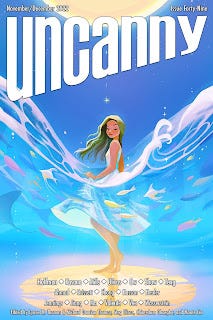
Rabbit Test
Samantha Mills
** spoiler alert **
A problem we can’t solve
I am reviewing only the story Rabbit Test, by Samantha Mills. I have marked this review a spoiler because I can't say why the story is so great without divulging the final lines
It is 2022 and it isn’t over.
It is 2022 and it is never over.
"It" is the fight over a woman's right to make her own decisions about her own body.
The title "Rabbit Test" refers to an early pregnancy test in which a woman's urine was injected into a young female rabbit. The rabbit would be sacced a few days later and its ovaries examined. If they were enlarged and yellow, that indicated the presence in the urine of the hormone hCG, indicating that the urine donor was pregnant. I mention this example in particular because it demonstrates the most striking feature of Mills' story: It leaps around in time, from 1021 (I think that's the earliest date, though I may have missed one) to 2119, showing the form of the struggle through the centuries. There are literally dozens of these historical (and future historical) vignettes.
Now, usually I like my history in the form of nonfiction, of thick, careful, scholarly works that carefully present the evidence that that historical event actually happened. What justifies historical fiction? It is, in this case, making it personal. As I read "Rabbit Test", I felt, over and over, the sting of personal injustice.
Speaking of nonfiction and the sting of personal injustice, "Rabbit Test" reminded me of this (highly relevant) paragraph from Gail Collins' America's Women
About a fifth of the pregnant women in New England died giving birth, and the figures were much higher in the South. Cotton Mather, ever one to look on the bright side, advised pregnant women that “PREPARATION FOR DEATH is that most Reasonable and Seasonable thing, to which you must now apply yourself.” Wealthy women had special sets of childbed linens, which they put on their beds after delivery was completed. If tragedy occurred, the linens became the woman’s shroud. In an era in which masculine bravery was celebrated, it was the women who actually dared to stare down death on a regular basis.
Now, there is a small paradox in the success (multiple awards!) of "Rabbit Test". Mills writes, "It is 2022 and it isn’t over. It is 2022 and it is never over." But the impact of this story on me, a citizen of the USA, is very topical. In 1973 our Supreme Court ruled that the US Constitution implies a right to abortion. That decision stood (with some adulteration) until last year. In those fifty years, many people thought "it" was over, at least here in the USA. It wasn't. Almost exactly one year ago (24-Jun-2022, to be exact) the Supreme Court overturned that 1973 decision.
It is 2023 and it isn’t over.
It is 2023 and it is never over.