

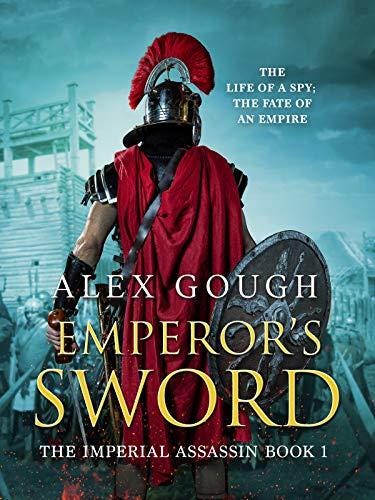
Emperor’s Sword
Alex Gough
Realistic, historically precise, emotionally flat
Emperor's Sword is the first novel in Alex Gough's Imperial Assassin series. It is a story of a soldier in battle. The soldier, Gaius Sergius Silus, (generally just called Silus), is the Assassin referred to in the series title. The emperor (although he is not quite emperor yet) is Marcus Aurelius Antoninus, known by his nickname Caracalla. The story takes place in third-century Britain. At this time the south of Britain was ruled by the Roman Empire. The wilder northern half is under the control of British tribes. Silus himself is the son of a Roman father and a Britannic mother and speaks both Latin and a British dialect. When the story starts he is a skilled spy -- in the course of the story he is recruited into a corps of secret assassins and spies.
It's a story of men at war. It is action-packed and accurate enough to make it completely clear to me that Gough knows much more of the relevant history than I do. It reminded me of several other books, the list of which I will mostly consign to a footnote1. But it is strangely less engaging as a story than any of those other works. Silus feels emotionally flat to me. I don't know why -- lots of things happen to Silus that produce powerful emotions. In him, that is -- but not in me. I can't explain this.
I think part of the problem is that Silus feels very ordinary. He talks like people I run into every day. He doesn't act like them -- I am not personally acquainted with assassins and spies (as far as I know). I suspect Silus's ordinariness is a conscious choice on Gough's part.
But here's the thing -- it is right not to trick a third century Roman soldier out with artificial exoticness. But, realistically, a third-century Roman soldier would, by upbringing and experience, be exotic to a 21st-century reader. Of the stories that Emperor's Sword reminded me of, the one that felt most similar was All for the Union: The Civil War Diary & Letters of Elisha Hunt Rhodes. This, even though there is a gap of a millennium and a half between them.
Rhodes, like Silus, fought savage opponents through a largely wild country. (The most conspicuous difference is that the missile weapons of Silus's time were arrows and lances -- those of Rhodes's war were firearms.) Rhodes is a plain-spoken soldier. Yet I felt more emotionally engaged with Rhodes than I did with Silus. Rhodes is not exactly exotic -- he's very relatable. Yet he didn't feel to me like the people I run into every day. He's a product of a different time and culture in a way that I feel in every word.
Despite this, I enjoyed Emperor's Sword and intend to continue reading the Imperial Assassin series.
All for the Union: The Civil War Diary & Letters of Elisha Hunt Rhodes, by Robert Hunt Rhodes, Puck of Pook's Hill, by Rudyard Kipling (particularly the chapters starring Parnesius), Soldier of the Mist, by Gene Wolfe, and Claudius the God and His Wife Messalina, by Robert Graves. There are of course thousands of fictional and nonfictional stories of soldiers at war -- this is merely a short list of the ones that popped into my mind as I read Emperor's Sword.
Thanks for sticking with the series. Interesting how your reviews document both the growth of the main character and my growth as a writer.