

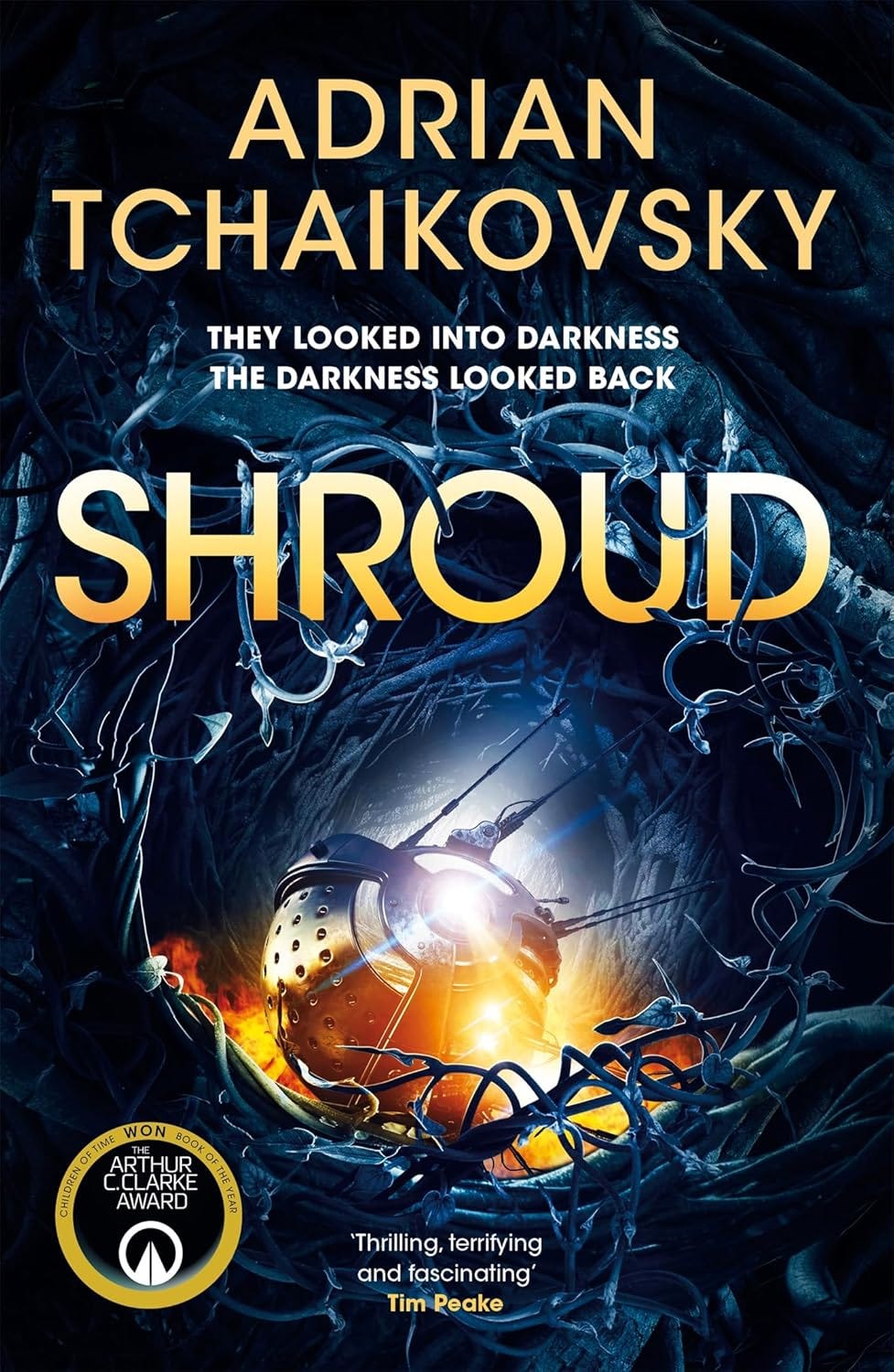
Shroud
Adrian Tchaikovsky
That was extraordinarily painful
Here are the finalists for the 2026 Best Novel Hugo:
★★★★★ A Drop of Corruption by Robert Jackson Bennett
★★★☆☆ Death of the Author by Nnedi Okorafor
★★☆☆☆ Shroud by Adrian Tchaikovsky
★★★★★ The Everlasting by Alix E. Harrow
★★★★☆ The Incandescent by Emily Tesh
★★★★★ The Raven Scholar by Antonia Hodgson
Adrian Tchaikovsky's Shroud was the last novel finalist I read this year. Despite his obvious talent, I have found that Tchaikovsky disappoints more often than he pleases. In my opinion, he tries far too hard to teach. He does this at the expense of story-telling. Shroud is the least enjoyable thing by Tchaikovsky I have read. It is, in fact, high up on the list of all-time painful reads.
It's a post-apocalyptic novel. The apocalypses are called the first bottleneck and the Second Bottleneck. As the names suggest, these were apocalypses of the environmental/resource variety. Humanity survived by diaspora -- spreading to other star systems that still have resources to be extracted, and by corporate slavery. Everyone is a slave of the Concern. It is not called "slavery" -- slavery seldom is. There's always a euphemism.
Our first-person narrator, Juna Ceelander, is a member of a team of half a dozen specialists. They are tasked with the job of working out how to exploit Shroud, their name for a moon of a gas-giant that orbits a star distant from Sol. Shroud is extremely inhospitable. It has an atmosphere that is essentially opaque, and therefore everything is dark, hence the name. Juna and her colleague Mai Ste Etienne crash-land on Shroud. Most of the novel recounts their long, painfully long, very painfully long odyssey across the surface of Shroud to a point from which they hope they can be rescued. Throughout this journey they are in pain, injured, in despair, and drugged to the gills. This was really, really hard to read.
There is, as it happens life on Shroud. [spoiler1]
Here's my ranking of this year's novel finalists:
1. The Raven Scholar by Antonia Hodgson
2. A Drop of Corruption by Robert Jackson Bennett
3. The Everlasting by Alix E. Harrow
4. The Incandescent by Emily Tesh
5. Death of the Author by Nnedi Okorafor
6. Shroud by Adrian Tchaikovsky
Here we get something very typical of Tchaikovsky—a thought experiment from the philosophy of mind turned into a novel. Tchaikovsky presents us with a synthetic intelligence composed of individual unintelligent organisms. The usual version of this in the philosophy literature is an ant-hill intelligence. There is, IMO, nothing original or very interesting in Tchaikovsky's elaboration of the idea. So, that was tedious.