

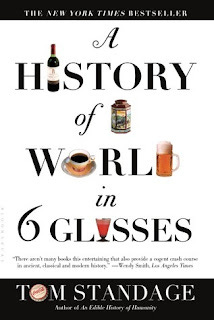
A History of the World in 6 Glasses
Tom Standage
Spoilage vs spoilage
Tom Standage is a deputy editor of The Economist. The Economist is a weekly news magazine that insists on being called a newspaper, for weird historical reasons that they are happy to explain to you. Despite its name, The Economist is no more focused on economics than other news magazines. It is more focused on intelligence, both in the sense of smarts and information about things we want to understand.
I mention all this because Standage's books are very much the kind of thing you would expect of someone who writes for The Economist, and who, what's more, came in as Science Editor. He writes what I might uncharitably call "novelty history" books -- little books focusing on particular historical vignettes. A History of the World in 6 Glasses is a perfect example. It describes the history of six drinks: beer, wine, spirits, coffee, tea, and Coca-Cola, using them as a vehicle to present a potted history of the English-speaking world.
I'm being snarky, but in truth, I enjoyed 6 Glasses a lot, as you already know from my five-star rating. It was a fun read, never dragged, and I learned a great deal.
There is one fact you need to know to understand any deep history of food and drink. It's a fact you already know: food and drink spoil. Even plain old water becomes dangerous to drink if you're not careful. Nowadays we slow spoilage mainly by keeping things cold, but that option has only been widely available for about 100 years. In olden days other tricks were necessary.
One of the best of these tricks was to let the food or drink spoil a little in a well-defined way. It's a bug-eat-bug world out there, so the bugs that make your barley malt spoil fight against other bugs that cause spoilage and keep it from spoiling so badly as to be inedible. Beer arose mainly as a way of preserving barley from spoilage, and also of making a drink that could be kept around safely. Soak the barley in water, so that the maltose (sugar) leeches out, then let yeast spoil it, producing a poison -- alcohol -- that kills other bugs but that humans can tolerate fairly well -- and even enjoy. Humans are weird!
This is such a good trick that it's been used over and over in culinary history --wine, yogurt, cheese, kimchi, etc.
Distilled spirits are not so much a way of controlling spoilage as a more efficient and portable technology for getting drunk than fermentation alone can produce.
Coffee and tea are a slightly different solution to the spoilage problem. Kill the bugs by heating the beverage, then poison it with vegetables. Vegetables that don't want their leaves and seeds to be eaten fill them full of poisonous alkaloids, e.g. caffeine, theophylline, theobromine, ... nicotine.
Humans were weird once again -- they came to enjoy these drinks for the sake of their poisons. This is also more or less where Coca-Cola came from. It was made by steeping coca leaves and kola nuts.
I don't know what a serious historian would think of this book. But I am a serious biologist, so it overlaps quite a bit with my expertise, and I loved it.