

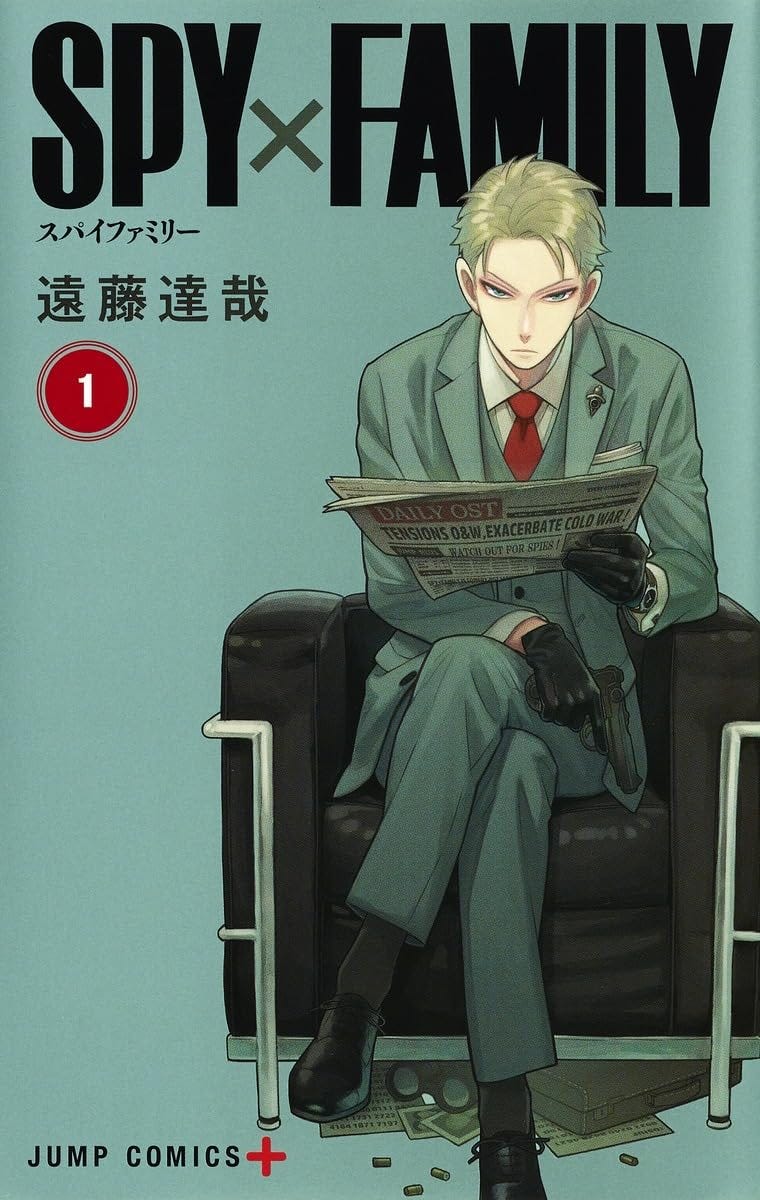
Spy x Family, Vol 1, Japanese edition)
Tatsuya Endo
Furigana and the Cold War
I have a thing I do to build foreign language vocabulary. I read a book in the language I’m trying to learn, Japanese this time. I read one page at a time. For each page I look up all the words that are new to me and add them to my flash card program (Anki). I add five new cards to my drill every day. When I run out of new words in my Anki decks, I read another page and add the new words. This is a V-E-R-Y S-L-O-W way to read a book. I worked my way through the Japanese edition of Spy x Family, Vol. 1 from 13-Feb-2025 to yesterday, 14-Feb-2026, so about a year and a half. It does get quicker as one goes along, as fewer words are new.
This is no way to enjoy a book. Therefore I started by reading an English translation. I did that in one day, 20-Jan-2025. My review can be read here. Short version: it’s absurd fun. Everyone knows this. It’s one of the hottest Manga right now, and is even the basis for a cartoon show on Disney+, currently at two seasons and 37 episodes (25 in Season 1 and 12 in Season 2).
So, what new insights did I gain from reading it in Japanese? Well, not many. Most of my new insights came, not from the language per se, but from reading very slowly and carefully. For instance, on my first read I had somehow overlooked the very romantic scene in which our hero, the spy codenamed twilight, marries our heroine Yor in the midst of a battle, using the ring from a hand grenade as the wedding ring. I had also not realized how clearly the setting is based on Cold War Germany. I am old enough to have visited Berlin when it was still a divided city. The two rival nations here, Westalis (西国 -- the Japanese characters just mean “west nation”) and Ostania (東国 -- “east nation’) are obviously based on West and East Germany. The capital, “Berlint,” of course evokes Berlin, the formerly divided capital of East Germany.
I was pleasantly surprised to see that the printed text used furigana. Much of Japanese is written in borrowed Chinese characters, which in Japanese are called kanji. It is practically impossible to figure out how kanji are pronounced if you don’t know. For instance, here is how Japanese (meaning the language) is written in Kanji: 日本語. This is pronounced “nihongo,” but you have to just know that. “日,” for instance, which means sun, can be pronounced ni, or hi, or bi, or ka, or nichi, or jitsu. (I’m probably missing half a dozen other possibilities.) Now, there is also a phonetic Japanese alphabet (two of them, in fact, just to gratuitously complicate matters), and in that alphabet, called hiragana, “日本語” is written “にほんご,” where に means the sound “ni,” ほ means “ho,” and so forth.
When Kanji are written with furigana, tiny little hiragana characters are written alongside the kanji to tell you how to pronounce them. This is helpful to a learner like me. It’s also helpful to younger Japanese children. That’s presumably why Spy x Family, Vol. 1 has them. I don’t know if all Manga have furigana, or only those intended for kids. I am very glad that Spy x Family, Vol. 1 does.
So, on to Volume 2!