

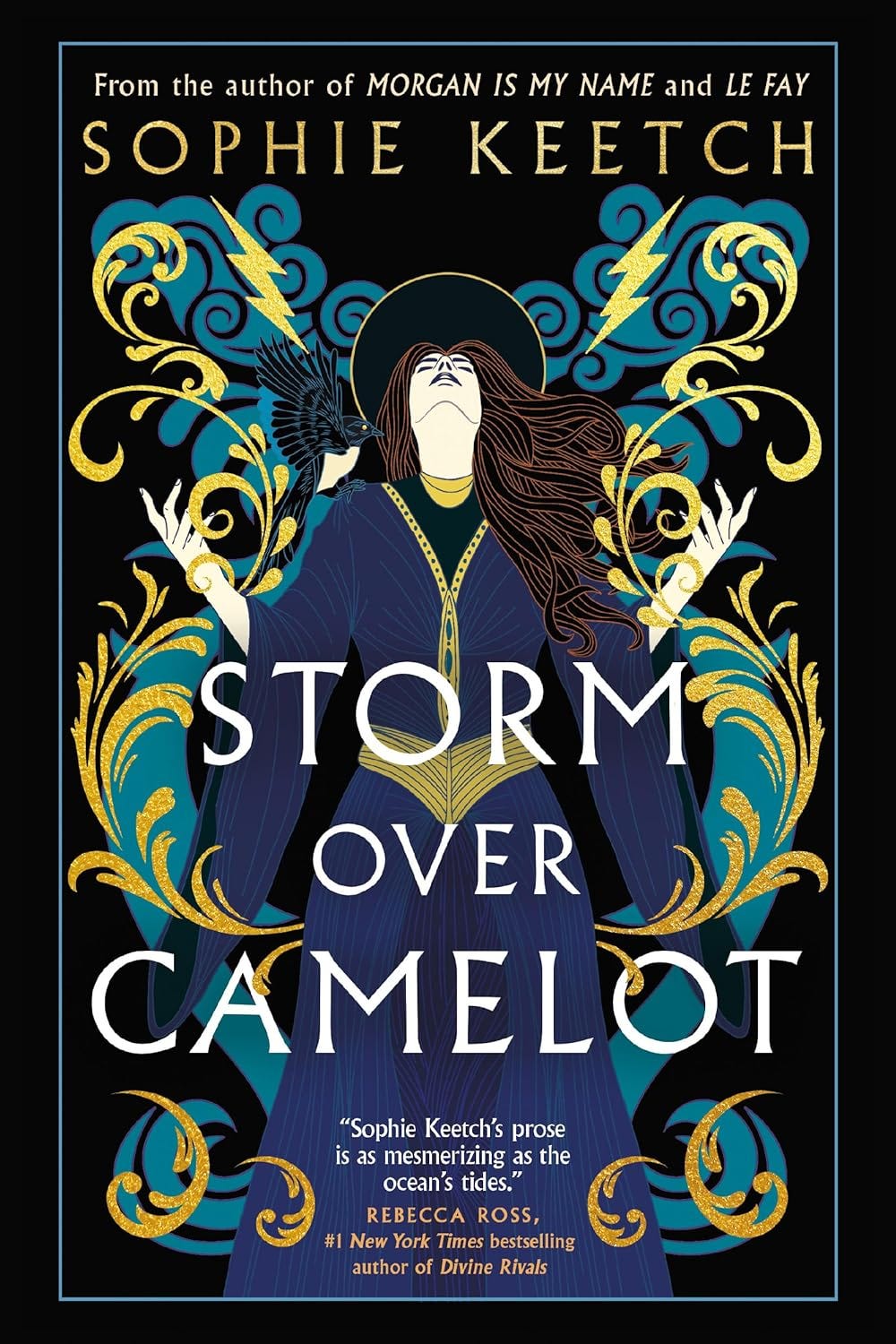
Storm Over Camelot
Sophie Keetch
This where it gets hard
The story of Arthur and the Knights of the Round Table is a tragedy. It is also -- this, I find, comes as a surprise to most folks -- a very adult story. There is a war in which Arthur dies. (Usually the reader is left in some doubt as to whether Arthur really died. The legend, of course, is that some future day, in Britain’s greatest need, Arthur will return to save her. This has not yet occurred.)
Arthur’s downfall is a consequence of incest and adultery. The incest is between Arthur and his half-sister. (In some versions of the tale the act is blamed on sorcery. As so often in these old stories, sorcery is used as an excuse to shift blame from a man to a woman.) The result is a child, Mordred, who eventually betrays Arthur in the attempt to become king in his place.
The adultery is between Arthur’s wife Guinevere and his greatest knight and greatest friend, Sir Lancelot du Lac. Arthur and Lancelot become estranged as a result, and the Round Table and Arthur’s court are split and disastrously weakened. It is this rift that Mordred takes advantage of.
In the classical stories Arthur’s sister Morgan is deeply involved in Arthur’s downfall.
Storm Over Camelot is Sophie Keetch‘s retelling of that tragic story. She begins with this apt epigraph
Let no one deem me a poor weak woman who sits with folded hands, but of another mould, dangerous to foes and well-disposed to friends; for they win the fairest fame who live their life like me.
—Medea, Euripides
Morgan is Arthur’s bitter enemy since he killed Morgan’s lover Accolon in battle (in Le Fay, book2 of the series). She is determined to avenge herself. She is also determined to bring Accolon back to life. (If you’re a reader of fantasy, you will recognize that as a red line. In literary fantasy, the attempt to deny or reverse death seldom ends well.)
The story is well done. Morgan remains the hero of her own story. She is not, in this retelling, an evil witch, though witch she may be. She may not always be in the right, but she always has reasons for what she does. My only complaint would be that it is slow at times. There are long periods in which Keetch dwells on Margan’s thoughts and feelings, when I would have preferred she reveal them through action.
Still Keetch‘s Morgan Le Fay trilogy is one of the best, possibly the best, retellings of Arthurian legend I have read.
Sounds like an excellent book! 💯
I like it when these books focus in on characters who are known as the villains and try to give us their thought processes. ⚖️
And sometimes they will change some things from how the stories traditionally go, which I say is totally fair game too.
I’ve written a short story from Mordred’s perspective that deviates big time from how his story usually goes, and it’ll probably end up on Substack eventually.
Thank you for sharing this review with us! 🙏