

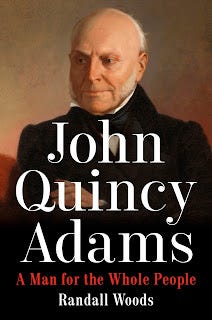
John Quincy Adams: A Man for the Whole People
Randall Woods
Sulfuric acid in his tea
John Quincy Adams was an early American politician who was at the center of events in the United States of America (and indeed, in the rest of the Americas) from the late 18th century until his death in 1848, only a few years before the cataclysm of the Civil War. He was the eldest son of founding father John Adams and founding mother Abigail Adams. In an age that included Thomas Jefferson and Alexander Hamilton he was one of America's foremost intellectuals. I would divide his career into three phases: diplomat: 1794-1825, President 1825-1829, and finally crotchety old congressman (1831-1848).
I have often read that in its early years, the USA was in grave danger of ceasing to exist, but before reading this biography, I never really understood why. The answers are actually quite simple: England and France. England, from the earliest years of the USA, regarded it somewhat as China now regards Taiwan: as a breakaway colony with no right of separate existence. France aided the American Revolution and expected its pound of flesh in return. But not long after the American Revolution France had its own revolution (inspired in part by the American one), which after a lot of complicated fuss that you've read about elsewhere, resulted in Napoleon coming to power in France. The USA was one of the bones over which these two big dogs fought. JQA served the USA in many roles during this time, but primarily as its most prominent diplomat. In this role he played England and France off against each other delicately in such a way as to prevent the baby USA from being swallowed.
He was at the center of many historical events. Prior to reading this biography, I had not realized that JQA was in St Petersburg serving as the US Ambassador to Russia during Napoleon's disastrous invasion in 1812. JQA was a diplomat in Paris during The Hundred Days when Napoleon escaped from Elba and tried to resume power. JQA's wife Louisa, who had been left behind in Russia because she was pregnant and travel was not safe, made her own way from Russia to Paris with a newborn daughter and arrived at Paris just as Napoleon did. (Frying pan/Fire!)
Subsequently JQA became Secretary of State (head diplomat) of the USA under James Monroe, where he had a dominant role in writing the Monroe Doctrine, which signaled that the USA would no longer be a chew toy fought over by England and France.
He then became President -- note, I don't say that he won the Presidential Election, because he didn't. No one did. Andrew Jackson won more electoral votes than any other candidate, but not a majority. The House of Representatives gave the Presidency to JQA. As President, he was pretty much a comprehensive failure. Jackson was what we would now recognize as the leader of an authoritarian cult, and his partisans controlled all the levers of power in Washington and thwarted JQA, who, whatever his gifts as a diplomat, was not and never would be a skilled politician.
Jackson succeeded JQA as president. JQA, however, was elected to the House of Representatives, where he served much against the will of his wife Louisa and son Charles. As a representative he fought the political battle against slavery. It was during this time that Ralph Waldo Emerson, witnessing JQA's rhetorical battles in Congress, wrote "He is an old roué who cannot live on slops, but must have sulfuric acid in his tea." He died of a stroke suffered on the House floor in 1848. Although slavery in the USA was to persist another 15 years, JQA contributed to the strength of the anti-slavery political movement. Indeed, Randall B. Woods writes, "Among those in the room who witnessed his demise was the young antislavery congressman from Illinois, Abraham Lincoln."
Woods's biography doesn't have an epilog, but most Americans know what happened next. Lincoln became President in 1861, the slave states withdrew from the USA to form a new nation, the Confederate States of America, the USA made war on the CSA and won, abolishing slavery in the process, and everyone lived happily ever after. (OK, that's a lie. We're still fighting the Civil War.)
I enjoyed John Quincy Adams: A Man for the Whole People, but was glad to reach the end. JQA is a fascinating subject, and Woods is careful to tell you every significant detail of his life, along with many that are less significant. I honestly found myself asking at many points, "Why are you telling us this?" If you are interested in American history (and I include in that North, Central, and South America), you will learn a lot from this biography.