

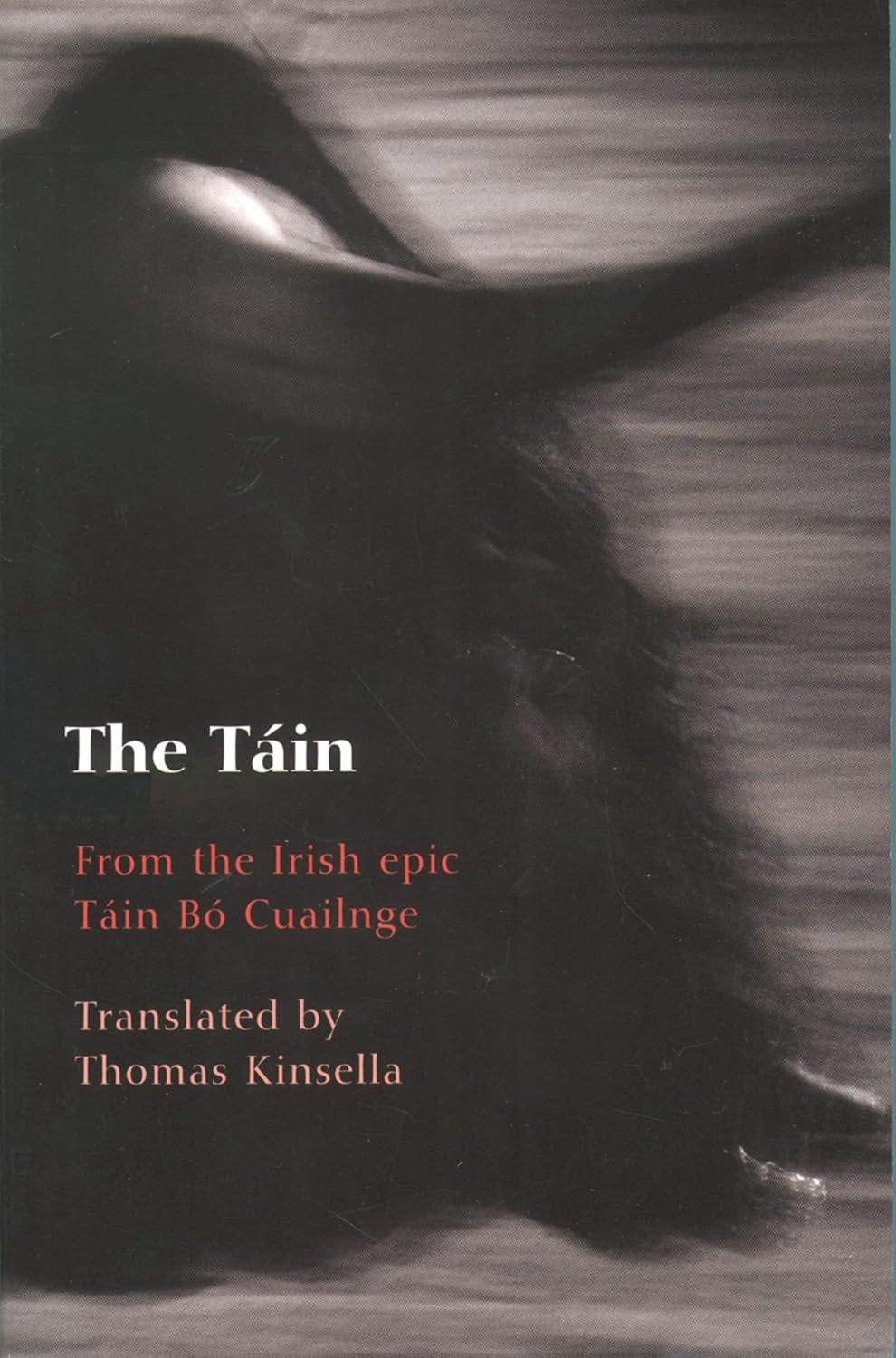
Táin Bó Cuailnge
translated by Thomas Kinsella
** spoiler alert **
Cúchulainn’s great fight
The Táin Bó Cuailnge is a classic of Irish folklore. It tells the story of an invasion by the Irish province Connacht, led by its Queen Medb and King Ailill into the province of Ulster, ruled by Conchobor, with the aim of stealing Ulster’s prize bull Donn Cuailnge, which Medb coverts because she wants to have a better bull than her husband Ailill. The warriors of Ulster are superior to those of the rest of Ireland, and indeed, the rest of the world. (In case you haven’t twigged yet, this is an Ulster story told by Ulstermen, without even the slightest pretense of objectivity.) The raid is feasible only because the men of Ulster suffer a curse called the pangs of Ulster that temporarily disables almost all of them.
One hero is left able to fight for Ulster: the 17-year-old boy Cúchulainn. He single-handedly holds off all the other armies of Ireland until the Ulstermen recover from the pangs. Most of The Táin recounts Cúchulainn’s fights against the Connacht fighters. He is always victorious and single-handedly destroys most of the thousands of Connacht fighters. Eventually the Ulstermen recover from their pangs and come out to fight off Connacht.
From a modern point of view the whole story is deeply, deeply stupid. That is partly because the Ulster bards who told the tale wanted Connacht to look stupid. But from the perspective of the twenty-first century the Ulstermen hardly come off better. Indeed, even the (probably) eighth century scribe who copied out what is now the Book of Leinster, wrote in a Latin endnote
I who have copied down this story, or more accurately fantasy, do not credit the details of the story, or fantasy. Some things in it are devilish lies, and some poetical figments; some seem possible and others not; some are for the enjoyment of idiots.
It becomes obvious if you think about it that the battle and slaughter are the point. These men want nothing more than a chance to die in battle. They may have a slightly preference for being victorious in battle, but if so, it is very slight. They want to fight famous battles and be remembered ever after. The Táin was written down in the 8th century but the story itself clearly dates to an even older oral tradition, before the fifth century. And here I am reading it in 2026. So, yeah, boys (and the occasional girl), you got your wish.
Translator Thomas Kinsella worked hard to assemble this story in coherent form from the several ancient manuscripts that tell pieces of it. I do not myself know anything about ancient Irish, so I can’t judge the translation per se. But it has all the hallmarks of careful work.