

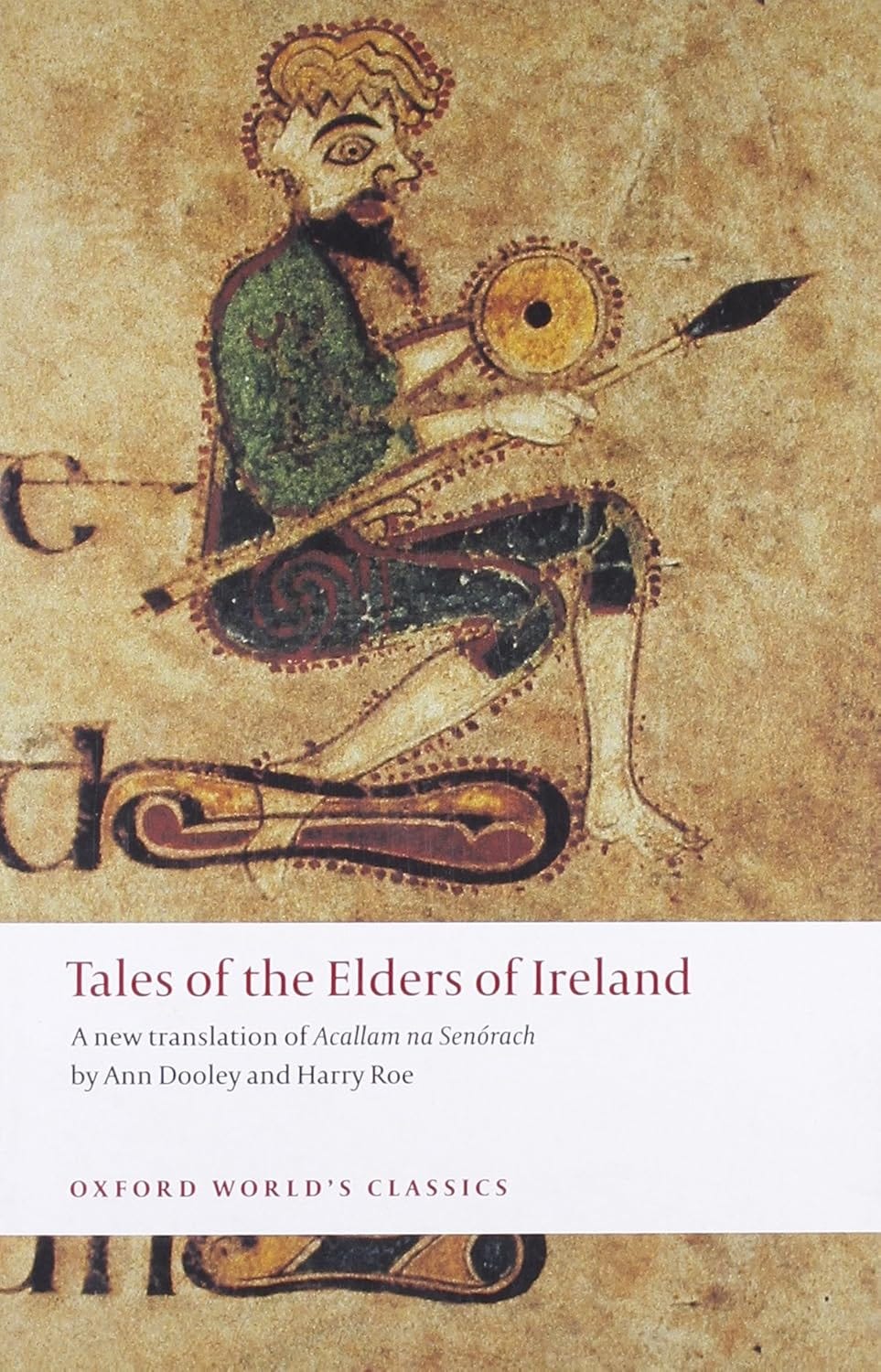
Tales of the Elders of Ireland
Ann Dooley (Translator), Harry Roe (Translator)
Let us all praise Dear Leader Patrick
Early in its history, Ireland had a problem that many peoples have had, deriving from limited land and primogeniture. If you’re a Big Man (women need not apply) with enough land to support your family and soldiers (we will come to why you need soldiers presently), you need to avoid dividing that land. A fertile man is likely to have more than one son. (Polygamy was a thing.) You cannot pass your land on to all of them. The practice was to hand it down to the oldest son.
What do you do with the spares? Well, in early Ireland (and other places) many of these young men joined bands of brigands. In Ireland the brigands were called Fianna. They hunted, raided the cattle of propertied folks (hence the need for soldiers), hired themselves out as mercenaries. (And got themselves killed, pretty often.) The oldest Irish folklore concerns the Fianna. If you doubt the hold that the Fianna have on Irish imagination, note the name of the current (May-2026) largest Irish political party. Of course, Fianna Fáil would object to my use of the word “brigands” to describe the legendary Fianna, but they would, I suspect, wink while objecting.
I don’t think the time of the Fianna can be precisely dated, but generally they were civilized and suppressed by the Christian church. Thus the conversion of Ireland by Patrick (ca. 387 - 461 CE) can be taken as the approximate end of the Fianna.
The longest written work of Fianna folklore that has come down to us is Acallam na Senórach, “Colloquy of the Ancients,” of which Tales of the Elders of Ireland is a translation. Acallam na Senórach dates from the late 12th or early 13th centuries. You will notice that the 12th century was a long, long time after Patrick. You would be justified in doubting how authentic a report of those legends it can possible be.
It gets worse! The Church obviously had issues with the Fianna, of which polygamy, thievery and murder were near the top. Acallam na Senórach is a propaganda tract that takes the point of view that, while these stories are all very interesting, it is a Very Good Thing that the church has now triumphed.
Acallam na Senórach purports to be a series of stories told to Patrick by Caílte mac Rónáin, one of the most prominent of the Fianna, after Caílte’s conversion to Christianity by Patrick. Caílte was a nephew of the last and most famous of the chieftains of the Fianna, Fionn mac Cumhaill (whom you may have heard of as Finn Mac Cool). In general Caílte wanders around Ireland, and whenever he comes to a new place, someone (most often Patrick) asks him why this place is named what it is. And Caílte tells the story of that place. Some of these stories are good, but most are repetitive pastiches of boasting of the prowess of the Fianna.
Also, Patrick is a terrible person. For instance, here is an early story
Priests went off to Becan’s house and Benen asked him for lodging for Patrick. Becan had eight score milch-herds, and yet he refused them an evening meal. Benen and the clerics then returned and told their tale to Patrick. Patrick said, ‘Let not one of his livestock or of his household survive until tomorrow.’ This indeed happened, just as Patrick said.
Patrick is the dictator of Ireland. He expects and receives extravagant, North Korean dictator-level, praise -- he grants earthly wealth and heavenly bliss to those who praise him, and death and damnation to those who fail of obsequious obedience. I cannot believe that the modern Roman Catholic Church would approve this account of Patrick.
Thus, Tales of the Elders of Ireland was more of a disappointment than a pleasure. Also, I need to mention an extraordinary gap: there is no index. Since the book is not available in electronic format, good luck if you want to find anything!