

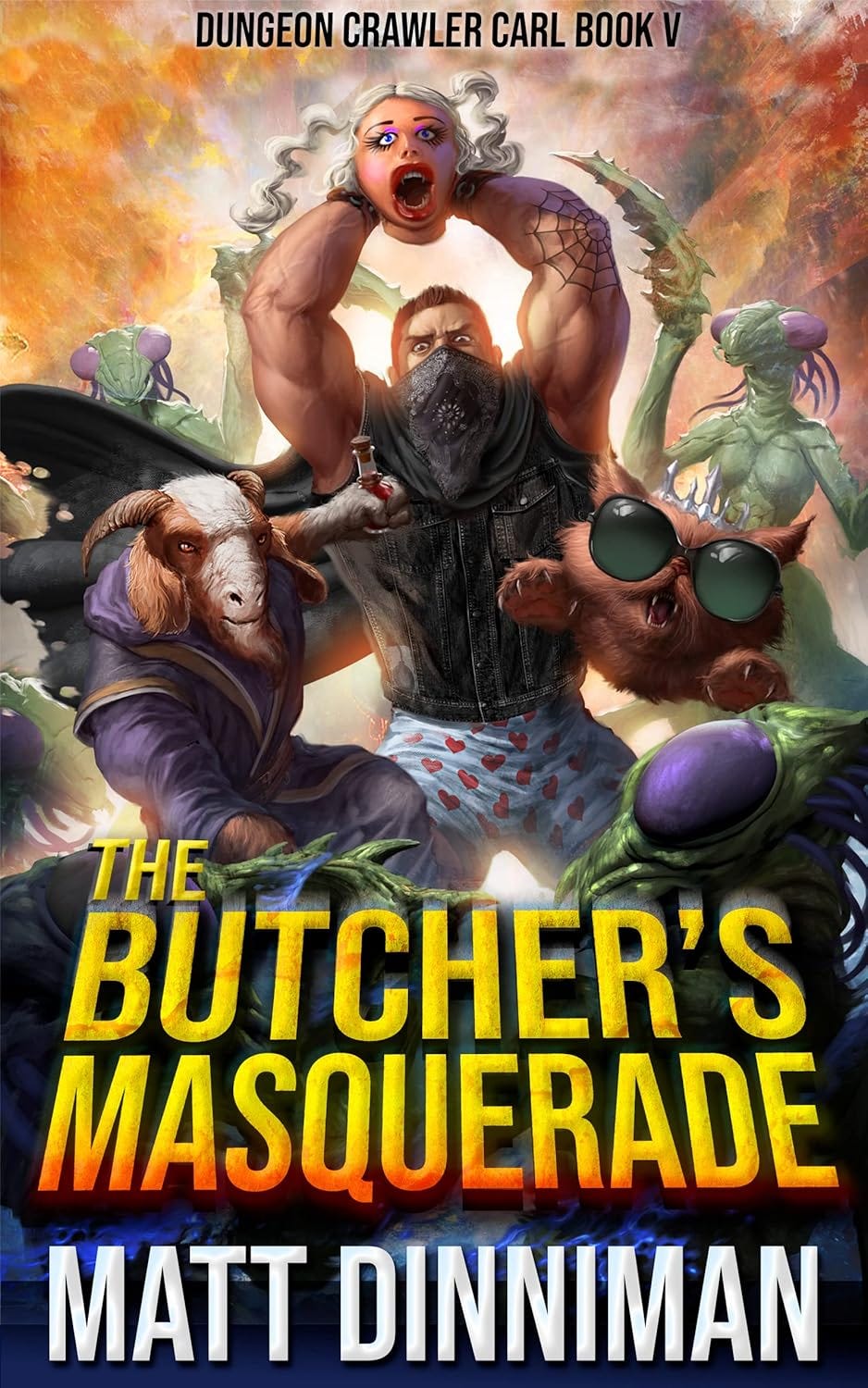
The Butcher’s Masquerade
Matt Dinniman
Donut does too love Carl!
In my review of Dungeon Crawler Carl, the first novel of Matt Dinniman‘s series, series, I pointed out a problem
Although Carl and Donut frequently battle very dangerous monsters, we never believe they’re in real danger of being ended... This is a series of eight books, and we need Carl and Donut for it to continue.
That, I thought, meant that the stakes were doomed to be low.
I was wrong. I have just finished novel 5, The Butcher’s Masquerade, and so far every novel has been better than the preceding one. That can’t continue forever -- it is amazing that Dinniman has kept it up for five novels. He has done this by raising the stakes. He does so in, I think, two main ways.
First, Carl recognized almost from the start that his fellow crawlers, those he and Princess Donut were expected to kill, were not the real enemy. The real enemy was the system that devised and ran the dungeon as entertainment. Because even if Carl and Donut have plot armor and cannot really die, those who are killed in the Dungeon do truly die. And the damage to Carl and Donut and the other surviving crawlers is real. Paraphrasing Lincoln, “As I would not be killed, so I would not be a killer.” Carl and Donut are suffering real damage because of all the killing they have been forced to. (Indeed, the word “masquerade” in the title alludes to this, in a way that becomes clear near the end.)
Second, Carl and Donut have formed alliances with other crawlers. And of course the oldest such alliance in the series is that between Carl and Princess Donut themselves. That is inevitably a bit more of a focus in this novel because of a plot twist at the end of the previous novel, The Gate of the Feral Gods. Mercenaries found and kidnapped Carl’s Ex Bea, who was also Donut’s owner. It was inevitable that the entertainers who run the show would try to confront Carl and Donut with Bea to pump up ratings.
I enjoyed this plot line because it scratched a personal itch of mine. While it is not literally true that “Love makes the world go round,” (that would be angular momentum) it is pretty close to true that “Love makes the literary world go round.” Sadly, the love that makes the literary world go round is almost entirely of the romantic variety, boys and girls in relationships intended to turn sexual. (Or more recently -- we can cheer for this -- boys and boys or girls and girls in romantic relationships.) But there are so many other types of love: the love between parents and children, the love between friends. It is tiresome almost beyond enduring that authors don’t find it worthwhile to tell these love stories as much as romantic love stories.
I have never been sure whether Princess Donut really loves Carl. That question is close to the heart of The Butcher’s Masquerade.