

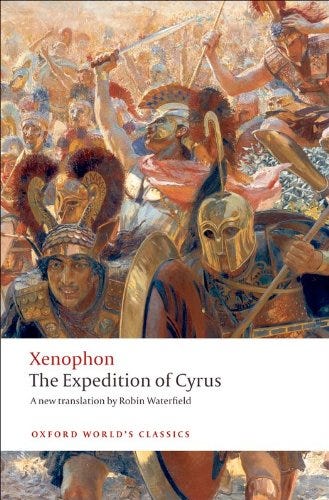
The Expedition of Cyrus (Oxford World Classics)
Xenophon
An old book about fighting men
The Expedition of Cyrus (more commonly known by the title Anabasis) is a classic of Greek literature. It was written by Xenophon of Athens (this is how he refers to himself throughout the story) and tells the story of an army of Greek soldiers who were left stranded in the Persian Empire (more or less what we now call Iran) and had to fight their way out to get home. It was written sometime around 400 BC.
Cyrus was a prince of the Persian Empire who wanted to be king. He had Greek friends. He used them to recruit an army of 10,000 Greek hoplites (heavy infantry) under false pretenses and led them into the empire. Greek armies were the best in that part of the world at that time. Once they had gone too far to have any other way out, Cyrus led them against the his brother Artaxerxes II the king. Cyrus himself was killed in the battle of Cunaxa, The Greek generals, deceived by Tisaphernes (one of Artaxerxes satraps), were captured and killed.
That left the ten thousand stranded in hostile territory, without leaders or maps or any local knowledge, surrounded by enemies. Xenophon had joined the expedition at the invitation of a friend. Although not strictly speaking a member of the army, he stepped up and together with the Spartan Chirisophus led the ten thousand. They fought their way north to the Black Sea. The moment when the ten thousand saw the sea from the top of a nearby mountain is famous in literature and history. From there most of them, Xenophon included, managed to make their way home. If the story were fiction they would have gotten home much quicker after the climax of reaching the sea. Being constrained by reality, Xenophon's climactic moment occurs at about the midpoint of the book. Even so, it's a good story.
I had not realized before reading the Introduction of this Oxford World Classics edition how prolific an author Xenophon was. I had previously read Anabasis and also some Socratic dialogs he had written -- in his youth, Xenophon had been one of the young men who use to argue with Socrates. But he wrote many more books than that. Furthermore, he owes much of his fame to his simple and straightforward Greek prose. (So they say -- I do not myself read Greek.) In England Latin and Greek were considered an essential part of a gentleman's education. Compared to such writers as Homer or Aristotle or, say Euripides, Xenophon's plain-told histories were easy reading. Thus generations of English schoolboys read Xenophon.