

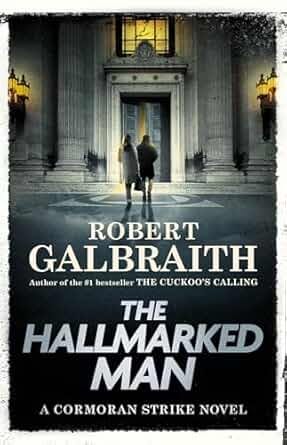
The Hallmarked Man
Robert Galbraith
** spoiler alert **
Ryan, Robin, Cormoran and a lot of booze
Each of Robert Galbraith's (AKA J.K. Rowling's) Cormoran Strike novels has two plots. First, there is a mystery for Robin and Strike to solve. Then, there is the ongoing drama of Robin and Strike's relationship. The mystery is the plot of This Novel, whichever novel we're talking about in particular. The Strike/Robin romance is the plot of the series as a whole. (I marked this review a spoiler because I intend to make some slightly spoilery remarks about the Robin/Strike negotiations. There will also be a major spoiler or two, but those I will hide inside spoiler tags.)
Now, I have for some time been feeling that the romance subplot had passed its sell-by date. They're not teenage kids. What's more, everyone around them knows they're in love with each other. In fact, it is nearly universally assumed among those who know them less well that they're boinking. (They aren't.) It's long past time they figured this out. I am not alone in this opinion -- I have read a bunch of other reviews of Strike novels, and it's clear that the audience in general is getting impatient.
In The Hallmarked Man the romance, specifically the Robin/Ryan/Strike triangle, has very nearly taken over the book. That's where our attention is concentrated almost throughout. We ended The Running Grave with two declarations of love. Cormoran finally told Robin he was in love with her. But the verb "told" overstates the case -- he told Robin that his dead psycho-ex Charlotte had believed that, and he did it in a way that acknowledged that Charlotte got it right. Also, Robin had been surprised into reflexively speaking the words "I love you, too," to Ryan Murphy. So now Ryan and Robin are an item, and Strike is of course unhappy about this.
In past novels, the blame for this failure of resolution mostly fell on Strike. In The Hallmarked Man it's mostly Robin screwing it up. She fails to recognize and acknowledge the true state of her feelings. Strike is also much to blame, though mostly in the sense that his stupidity in past novels has repercussions. His errors in this novel are less egregious, generally confined to awkwardness and poor communications. [spoiler1]
The second disappointment was that the mystery kind of stinks. Someone gets murdered in the vault of a London silver shop. The body is mutilated (head and hands cut off) in such a way as to make it difficult to identify. Robin and Strike are hired by Decima Mullins to prove that the body was actually that of Rupert Fleetwood, her boyfriend and the father of her child. Note the verb -- Decima is quite sure the body is Rupert; she just wants proof. Decima is, alas, a relative of the aforementioned dead psycho-ex Charlotte. Thus Charlotte's awful family is prominent in the book. (Yuck. I had hoped we were done with them.) Together with the police, Robin and Strike identify no less than five possibilities for the body donor. Most of the novel is spent tracking these people down. Thus the investigation is all over the place. [spoiler2]
There is a plot device I really dislike. It's when a supposedly smart character does something stupid in order to set a plot in motion. Rowling is far too skilled an author to do this without any explanation. But over and over in The Hallmarked Man she uses the same lame trick. Our erring character knocks back drink after drink, at a time when he/she really can't afford to be impaired, until he/she is too toxic to function adequately, then does something stupid.
The truth is, I was glad to reach the end of this one. Despite their length, this was the first time I felt that way when reading a Strike novel.
We don't get a final resolution of the romance subplot. In fact, the novel ends on a cliff-hanger, with Robin fending off dual marriage proposals. Guess we'll have to wait for book nine to find out how she handles the mess.
Once Strike finally buckles down to tracking Rupert down, he accomplishes it in a few pages. It's hard to read that without thinking, "This book could have been a whole lot shorter."