

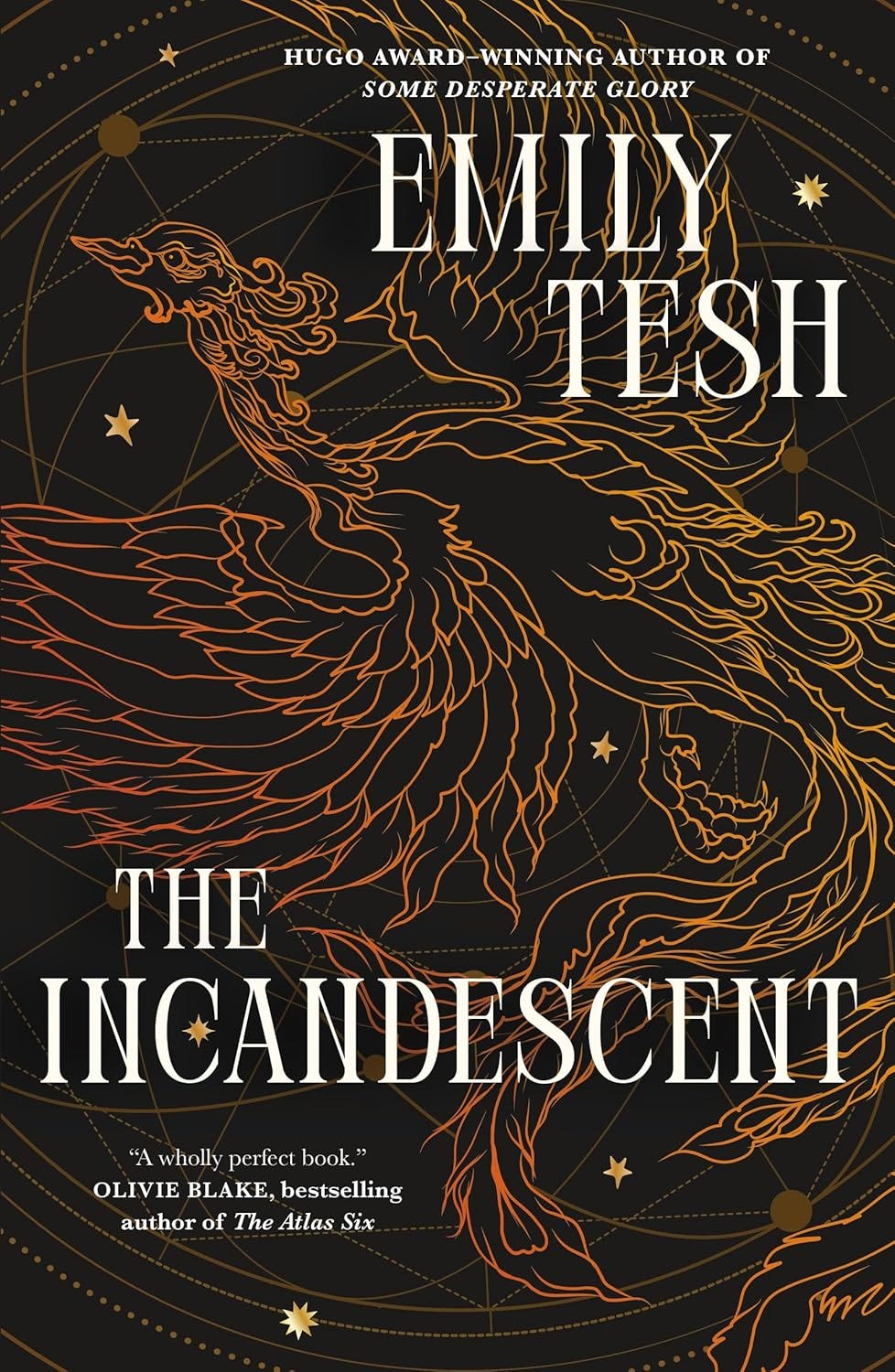
The Incandescent
Emily Tesh
A very long vignette about English boarding school
Here are the finalists for the 2026 Best Novel Hugo:
★★★★★ A Drop of Corruption by Robert Jackson Bennett
★★★☆☆ Death of the Author by Nnedi Okorafor
☆☆☆☆☆ Shroud by Adrian Tchaikovsky
★★★★★ The Everlasting by Alix E. Harrow
★★★★☆ The Incandescent by Emily Tesh
★★★★★ The Raven Scholar by Antonia Hodgson
Emily Tesh‘s The Incandescent takes its title from a poem by the incandescent Ogden Nash.
Tarkington, Thou Should’st Be Living in This Hour
O Adolescence, O Adolescense,
I wince before thine incandescence.
Thy constitution young and hearty
Is too much for this aged party.
Our protagonist, Sapphire Walden, helpfully quotes the first two lines -- otherwise I would have been at a loss to understand the title. Walden is not, for most of the book, one of those adolescents. She is the Director of Magic at Chetwood School, an English boarding school. She is, however, an Old Girl, which in the jargon of English boarding schools means “former student.”
The Incandescent is obviously a fantasy, because “Magic.” But for me personally, English boarding schools are as much a fantasy world as Tolkien‘s Middle-Earth, from Stalky & Co and Jennings through Hogwarts. I was educated in US public schools. Private boarding schools exist in the USA, but none of my acquaintance attended one, that I know of. Annual house point competitions are less real to me than Quidditch. Tesh is a former classics teacher at a well-known English private school (Haberdashers’ Girls School).
The Incandescent felt to me like a very long vignette portraying an English private boarding school, as painted by a highly placed insider. The magic was only marginally relevant. OK, that is misleading. There is a plot -- several actually -- and the plot is all about the magic. It’s not a very coherent plot. There are several distinct stories, connected only by the location (they’re mostly about Chetwood School) and by Walden’s involvement in them. It’s very stop-and-start.
I was puzzled by the title at first, because I read The Incandescent as singular, and there are a lot of incandescent adolescents (including young Saffy Walden). But then I thought to myself, “What wrong with you? You’re a native English speaker, and English doesn’t inflect adjectives. ‘The Incandescent’ can be plural as easily as singular.”
In the end, although I enjoyed The Incandescent, it didn’t feel like a novel to me. It will, I think, be #4 in my ranking of the Hugo finalists. (I haven’t read Shroud yet.)