

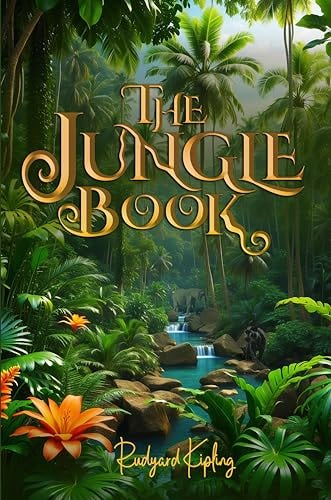
The Jungle Book (Illustrated): The 1894 Classic Edition with Original Illustrations
Rudyard Kipling
Best preface ever
I was around ten years old the first time I read Rudyard Kipling‘s Jungle Books, so around 1965. They became two of my favorite books in all of literature -- I’ve probably read them about a dozen times since. Two days ago I set out to reread them. (I’m writing a story that makes reference to them and wanted to get the details right.) I’ll write an actual review when I finish The Second Jungle Book. But I wanted to take the occasion of finishing The First Jungle Book to note that this particular edition lacks the preface, which is a shameful omission. Here it is, in full:
The demands made by a work of this nature upon the generosity of specialists are very numerous, and the Editor would be wanting in all title to the generous treatment he has received were he not willing to make the fullest possible acknowledgment of his indebtedness.
His thanks are due in the first place to the scholarly and accomplished Bahadur Shah, baggage elephant 174 on the Indian Register, who, with his amiable sister Pudmini, most courteously supplied the history of ‘Toomai of the Elephants’ and much of the information contained in ‘Her Majesty’s Servants.’ The adventures of Mowgli were collected at various times and in various places from a multitude of informants, most of whom desire to preserve the strictest anonymity. Yet, at this distance, the Editor feels at liberty to thank a Hindu gentleman of the old rock, an esteemed resident of the upper slopes of Jakko, for his convincing if somewhat caustic estimate of the national characteristics of his caste—the Presbytes. Sahi, a savant of infinite research and industry, a member of the recently disbanded Seeonee Pack, and an artist well known at most of the local fairs of Southern India, where his muzzled dance with his master attracts the youth, beauty, and culture of many villages, have contributed most valuable data on people, manners, and customs. These have been freely drawn upon, in the stories of ‘Tiger! Tiger!’, ‘Kaa’s Hunting,’ and ‘Mowgli’s Brothers.’ For the outlines of ‘Rikki-tikki-tavi’ the Editor stands indebted to one of the leading herpetologists of Upper India, a fearless and independent investigator who, resolving ‘not to live but know,’ lately sacrificed his life through over-application to the study of our Eastern Thanatophidia. A happy accident of travel enabled the Editor, when a passenger on the Empress of India, to be of some slight assistance to a fellow-passenger. How richly his poor services were repaid, readers of ‘The White Seal’ may judge for themselves.
You may find it here, and here is an explanation by Alan Underwood.
We had read “The White Seal” in school, so the last two sentences caught my attention. Here is the first paragraph of “The White Seal”
All these things happened several years ago at a place called Novastoshnah, or North East Point, on the Island of St. Paul, away and away in the Bering Sea. Limmershin, the Winter Wren, told me the tale when he was blown on to the rigging of a steamer going to Japan, and I took him down into my cabin and warmed and fed him for a couple of days till he was fit to fly back to St. Paul’s again. Limmershin is a very quaint little bird, but he knows how to tell the truth.
Thus I realized that the “fellow passenger” whom Kipling claims to have helped and from whom he heard the story was Limmershin, the winter wren. And of course I quickly realized that all the experts thanked in the Preface are animals.
Underwood says “The joke would hardly be appreciated by young children but would amuse adults.”
Mr Underwood, it falls to me to inform you that, at the age of ten, I thoroughly appreciated the joke, and it has remained in my memory in the sixty years since as one of the best of all literary jokes.