

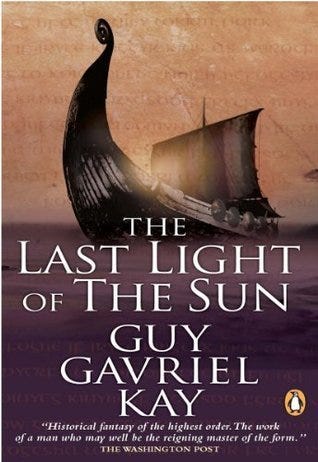
The Last Light of the Sun
Guy Gavriel Kay
Princes, princesses, and fairies of the north
When I read one of Guy Gavriel Kay‘s Quarter Turn Towards Fantasy historical novels, I always ask myself, “How much of this is real history, and how much made up?” GGK is usually fairly open about what bit of real history each novel reflects. For instance, in this one, The Last Light of the Sun, the acknowledgements mention English King Alfred the Great, the Welsh, and the Vikings. Alfred was, to a fairly good approximation, the first king to rule England. Before him England was a collection of tiny bickering kingdoms. It remained that during Alfred’s reign and after, but under Alfred the temperature of the conflicts went down -- he allowed settlements of Vikings in what is now England and mostly stopped fighting with Wales. Many of his subjects lived many of their years in something like peace.
It is not GGK‘s goal in The Last Light of the Sun to tell the story of Alfred. In this novel Alfred is Aeldred, King of the Anglcyn, the Vikings are the Erlings, and the Welsh are the Cyngael. Rather than tell Alfred’s story, GGK tells a smaller story about specific, less august persons. Aeldred is an important character, but not the most important. The heart of the story is an Erling raid on Anglcyn and Cyngael peoples.
Most of GGK‘s novels have an element of fantasy. In some of them it is small -- that is, there is magic, but it is peripheral to the story. You could delete all the magic from the story, make a few small additional changes, and events would proceed in much the same way. In others, and this is one, the magic is important to the plot. There are faeries in the book, and they play crucial roles.
The fae are, in an important sense, historically accurate. I always remember what Gene Wolfe wrote in his preface to Soldier of the Mist:
Modern skeptics should note that Latro [narrator of Soldier of the Mist] reports Greece as it was reported by the Greeks themselves. The runner sent from Athens to ask Spartan help before the battle of Marathon met the god Pan on the road and conscientiously recounted their conversation to the Athenian Assembly when he returned. (The Spartans, who well knew who ruled their land, refused to march before the full of the moon.)
The fae of ancient England and Europe were not cute little sparkly things. They were powerful and much feared. The old German word for a fairy was “Alb” (from which the modern English “elf” is derived). “Albtraum” still means “nightmare.” Even in Rudyard Kipling‘s children’s stories of Puck of Pook’s Hill and Rewards and Fairies it is acknowledged that England’s fairies anciently demanded human sacrifice. Kipling doesn’t dwell on it, because these are, after all, stories for middle grade kids, but it’s in there.
It is this (historically accurate, I would argue) role of the fae in The Last Light of the Sun that makes it such a powerful story.
The Last Light of the Sun on Amazon