

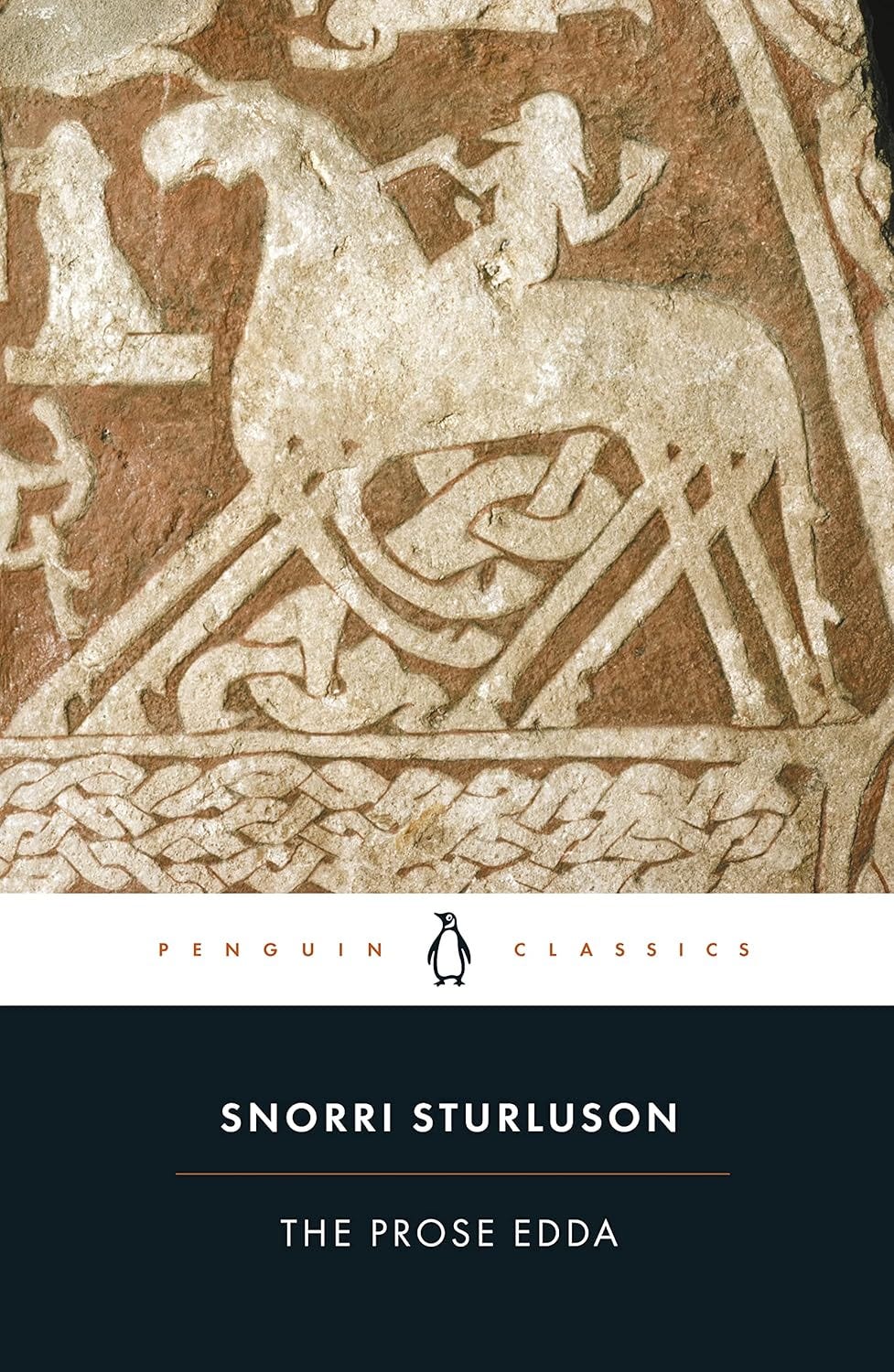
The Prose Edda
Snorri Sturluson, Jesse L Byock (Translator)
The more easily understood Edda
Most of our knowledge of Norse mythology and legend comes from two primary sources: The Poetic Edda (also called the Elder Edda) and The Prose Edda (also called the Younger Edda or Snorri's Edda). (And yes, the word "most" is a fudge -- several shorter works have come down to us and usefully fill in gaps.)
In the original The Prose Edda had four parts: a brief Prolog, then the Gylfaginning (the deception of Gylfi), followed by Skáldskaparmál (a kind of instruction manual for Norse poetic diction), and finally Hattatal (another instruction manual, this one on poetic meter). Translator and editor Jesse L. Byock omits Hattatal from this compilation, except for a fragment in Appendix 2.
The Gylfaginning takes the form of a riddle game. This form will be familiar to many readers. For instance, Richard Wagner begins his opera Siegfried with a riddle game, which serves as a recap of the first two operas of his Ring der Nibelungen. A very brief riddle game between Bilbo and Gollum lies at the heart of Tolkien's The Hobbit.
In the Gylfaginning the hero Gylfi visits the hall of the gods where he finds three manifestations of Odin. Everything that Gylfi sees is illusion, hence "The Deception of Gylfi." He challenges the Odins to prove their wisdom by answering riddles, and then proceeds to question them about the gods, their creation, and their history. This goes on for about 70 pages. Gylfi is a skilled interrogator and manages to get the story out of the Odins in a coherent and logically ordered form.
The Gylfaginning is easily the most coherent summary of Norse mythology I have read.
When you read Norse mythology and legend you quickly get used to everyone having a profusion of names. Odin alone has dozens (not even counting things like Woden or Wotan that are obviously just alternative ways of pronouncing "Odin"). For instance, he frequently cosplays as Grimnir, or he may be referred to more descriptively as All-Father, or any of at least a dozen other descriptive names. These many names are called "kennings." They are like Homeric epithets gone wild. The Skaldskaparmal is mainly an explanation of them. There is a fair amount of story-telling here, too, since to understand the kennings you must know the stories behind them.
I began my study of the Norse myth and legend primary sources with The Poetic Edda, then read The Prose Edda. That was the wrong order. I would advise anyone who wants to read the Eddas to begin with The Prose Edda, and only then move on to The Poetic Edda.