

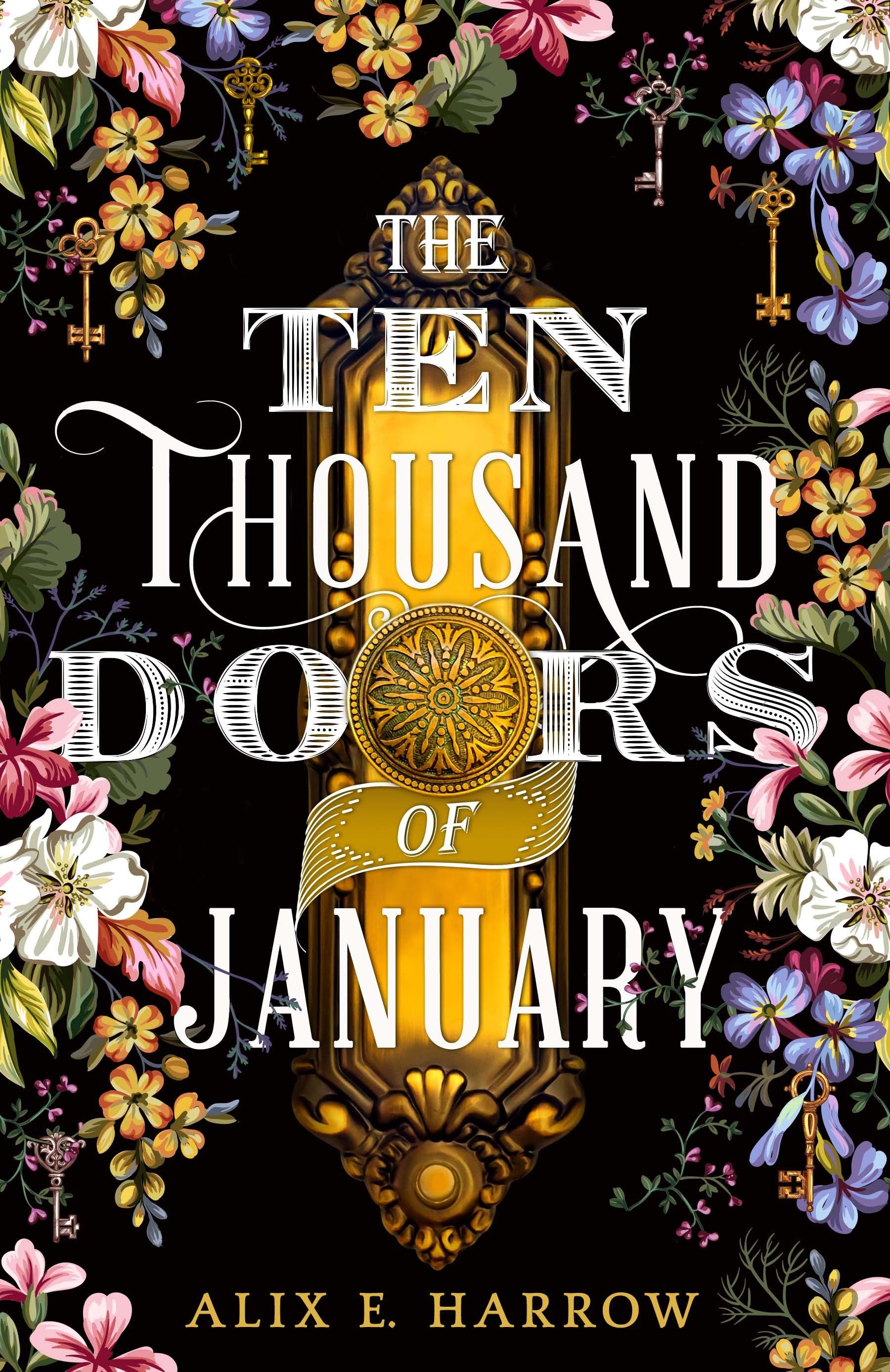
The Ten Thousand Doors of January
Alix Harrow
A reminder of why I read
Sometimes reading a novel becomes a chore. But now and then one comes along to remind me how worth it it is. Alix E. Harrow's The Ten Thousand Doors of January was like that. I was only a few chapters into it when I had the thought, "This is the reason I read."
And let me admit, up front, that I read for fun. I read for other reasons -- to broaden my mind, to gain insight into human nature, to learn wordsmithing. But at the pen of a good author, those things are all fun. I say, therefore, without self-contradiction, that fun books are, for me, the best books.
The Ten Thousand Doors of January is a fun book. It is, at base, portal fantasy. The Doors (note capitalization) of the title are portals that join worlds. Of course, that means that it takes place on multiple worlds, one of them Earth, or a place very like our version of Earth. The Earth part of the story takes place in the temporal vicinity of 1900.
Our hero and first-person narrator, January Scaller, is a person of color. She is, when the story begins, a sort of ward of Mr. William Cornelius Locke, a wealthy white (this is important) man for whom her father works. Her father, also a person of color, travels the world and acquires exotic items for Locke, which Locke keeps in his home in rural Vermont. January, who lives with Mr Locke, is one of the exotic items in his collection. January's mother is not in the picture.
January finds a scholarly work entitled The Ten Thousand Doors: Being a Comparative Study of Passages, Portals, and Entryways in World Mythology. The text of this work is included in its entirety in the novel. It is, obviously, about Doors. It is also, we gradually learn, connected to January herself. Many worlds are explored by the author of this book, and some of them by January herself. Some of them are inhabited by strange creatures -- well, to be accurate, by creatures that are ordinary in their home worlds, but that appear strange when brought to Earth. Thus we have vampires and wizards and witches, though not necessarily by those names.
This is one of those Ourobouros stories that eats its own tail. In the end, everything connects up nicely.
Ten Thousand Doors was, I believe, Harrow's debut novel. She was already a successful writer of short fiction when she began it, having indeed won a Hugo award for short fiction. The Six Deaths of the Saint is an extraordinary story that I recommend.
Harrow experiments, and her experiments don't always succeed. But this one does.