

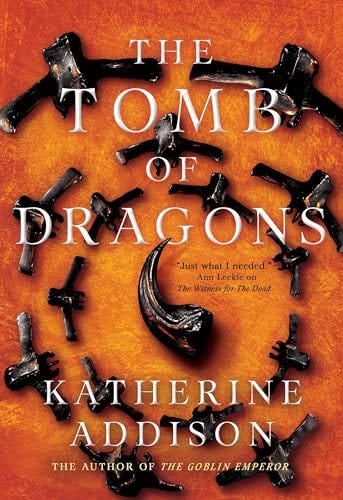
The Tomb of Dragons
Katherine Addison
With a little help from my friends...
I read Jane Goodall‘s classic In the Shadow of Man in 2000. (Trust me, I will make this relevant.) One of her earliest stories told of how Mike became the alpha male of the Gombe chimp band Goodall worked with. He did it in two ways. First, he was smart -- he figured out that he could make loud scary noises with discarded trash cans that would intimidate his rivals. Second, Mike had a friend he could rely on, David Greybeard. This story shows, among other things, that the people (mostly men) who bloviate about “alpha males” on the Internet have no idea what they’re talking about.
The Tomb of Dragons is the third (and, as of December 2025, last) novel in Katherine Addison‘s Cemeteries of Amalo series, which makes it fourth in her Chronicles of Osreth. In novel two, The Grief of Stones, our hero Celehar dispelled a powerful monster, a revethavar, at great personal cost -- he lost his personal gift for speaking with the dead. Being Witness for the Dead was Celehar’s calling. Having lost that ability, he is without purpose. So devastating is this loss, that all his friends fear he will commit suicide. They have organized to keep an eye on him, and his boss, the archprelate of Cetho, has found other occupation for him and arranged for a stipend to be paid him. Meanwhile, one of those friends, Velhiro Tomasaran, has taken over the job of Witness for the Dead from him, but still relies on him for help and advice.
Celehar is not anyone’s idea of an alpha male. However, he is unexpectedly powerful, and his route to power is, in broad outlines, the same as Mike’s. Like Mike, Celehar is smart. He also has the support of friends. He has friends because he is kind and good and absolutely incorruptible. One of those friends is Prince Orchenis, the ruler of his city, Amalo. When Vernazar, the corrupt chief prelate in Amalo, tries to get Celehar to lie to Orchenis for him, this conversation ensues.
“He’ll believe you because he likes you,” Vernezar muttered.
I stared at him.
“Oh, don’t be tiresomely disingenuous, Celehar. It’s hardly a secret that Prince Orchenis likes you better than any of Amalo’s native prelates.”
“Liking has nothing to do with trusting my probity.”
Vernezar snorted. “Only you would say that,” he said, not as a compliment.
“That’s why Prince Orchenis can trust him,” Captain Olgarezh pointed out.
Celehar even has the friendship of the Emperor Edrehasivar. (See The Goblin Emperor for that story.) Celehar is careful not to abuse the friendship of his powerful friends. He doesn’t bring them his problems. However, he will go to them when he has information he believes they will want. Both Orchenis and Edrehasivar are at pains to tell Celehar that, if people are trying to murder him (Celehar), they want to know that.
I cannot without spoiling explain how these friendships with powerful friends become relevant to the story. I will say only that the title, The Tomb of Dragons is relevant.
I thoroughly enjoyed this installment of Celehar’s story. I was happy also to see that it doesn’t have a neat ending -- it appears that there is more of Celehar’s story to come. Since The Tomb of Dragons was published this year, I think we can expect a sequel.With a little help from my friends...
I read Jane Goodall‘s classic In the Shadow of Man in 2000. (Trust me, I will make this relevant.) One of her earliest stories told of how Mike became the alpha male of the Gombe chimp band Goodall worked with. He did it in two ways. First, he was smart -- he figured out that he could make loud scary noises with discarded trash cans that would intimidate his rivals. Second, Mike had a friend he could rely on, David Greybeard. This story shows, among other things, that the people (mostly men) who bloviate about “alpha males” on the Internet have no idea what they’re talking about.
The Tomb of Dragons is the third (and, as of December 2025, last) novel in Katherine Addison‘s Cemeteris of Amalo series, which makes it fourth in her Chronicles of Osreth. In novel two, The Grief of Stones, our hero Celehar dispelled a powerful monster, a revethavar, at great personal cost -- he lost his personal gift for speaking with the dead. Being Witness for the Dead was Celehar’s calling. Having lost that ability, he is without purpose. So devastating is this loss, that all his friends fear he will commit suicide. They have organized to keep an eye on him, and his boss, the archprelate of Cetho, has found other occupation for him and arranged for a stipend to be paid him. Meanwhile, one of those friends, Velhiro Tomasaran, has taken over the job of Witness for the Dead from him, but still relies on him for help and advice.
Celehar is not anyone’s idea of an alpha male. However, he is unexpectedly powerful, and his route to power is, in broad outlines, the same as Mike’s. Like Mike, Celehar is smart. He also has the support of friends. He has friends because he is kind and good and absolutely incorruptible. One of those friends is Prince Orchenis, the ruler of his city, Amalo. When Vernazar, the corrupt chief prelate in Amalo, tries to get Celehar to lie to Orchenis for him, this conversation ensues.
“He’ll believe you because he likes you,” Vernezar muttered.
I stared at him.
“Oh, don’t be tiresomely disingenuous, Celehar. It’s hardly a secret that Prince Orchenis likes you better than any of Amalo’s native prelates.”
“Liking has nothing to do with trusting my probity.”
Vernezar snorted. “Only you would say that,” he said, not as a compliment.
“That’s why Prince Orchenis can trust him,” Captain Olgarezh pointed out.
Celehar even has the friendship of the Emperor Edrehasivar. (See The Goblin Emperor for that story.) Celehar is careful not to abuse the friendship of his powerful friends. He doesn’t bring them his problems. However, he will go to them when he has information he believes they will want. Both Orchenis and Edrehasivar are at pains to tell Celehar that, if people are trying to murder him (Celehar), they want to know that.
I cannot without spoiling explain how these friendships with powerful friends become relevant to the story. I will say only that the title, The Tomb of Dragons, is relevant.
I thoroughly enjoyed this installment of Celehar’s story. I was happy also to see that it doesn’t have a neat ending -- it appears that there is more of Celehar’s story to come. Since The Tomb of Dragons was published this year, I think we can expect a sequel.